
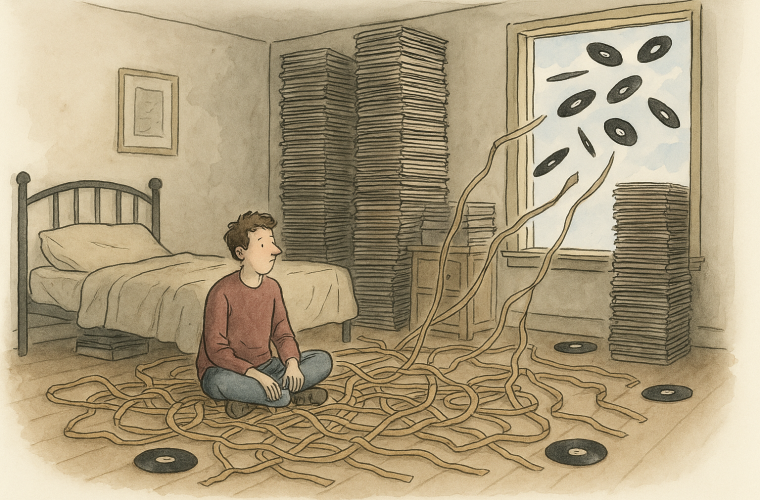
The stairs to the bedroom are carpeted in that beige weave you only find in houses built before the millennium, and halfway up there’s a stack of mailer boxes leaning against the bannister like a drunk waiting for a night bus. This is the warehouse. This is the dispatch centre, the customer-service department, and — judging by the unmade bed visible through the door — the staff canteen and dormitory besides. There is no neon. There is no espresso machine. There is a lad in his early twenties, a roll of brown parcel tape, and a milk crate of records that he is, with the unhurried devotion of a monk illuminating a manuscript, slipping one by one into protective sleeves.
‘What do you call this, then?’ I asked him.
‘The packing room,’ he said, not looking up. ‘Well. My room. It’s both.’
This, dear reader, is what won.
We were all told a story, weren’t we, about how this would go. The record shop — the proper sort, with the bloke behind the counter who’d sigh if you mispronounced a Krautrock band — was supposed to be killed by the internet. Murdered by Spotify and Amazon and the algorithm, finished off in a back alley by a teenager who’d never held a sleeve in his life. The future, we were assured, was frictionless, weightless, infinite, and free. The future was a server farm in Nevada.
And yet here we are, up a beige staircase, watching a young man weigh a parcel on kitchen scales.
The barriers fell, and look who walked through
Here’s the thing nobody quite reckoned on. The internet didn’t just hand the giants a weapon. It quietly demolished the walls that used to keep the little ones out. A generation ago, opening a record shop meant a lease, a shopfront, a till, a wholesaler who’d only deal with you if you bought by the pallet, and the small matter of standing behind a counter forty hours a week hoping somebody walked in. The cost of entry was a brick wall with your name on the mortgage.
Not any more. The same tools the disruptors built to flatten the high street are now sitting, free or nearly free, in the pocket of every clever twenty-two-year-old in the country. A payment processor that takes cards from forty countries before breakfast — sign up in an afternoon, no bank manager, no grovelling. A shipping label printed on the kitchen table that gets a parcel from a Leeds bedroom to a flat in Lisbon by Thursday. A supply chain so sophisticated and so accommodating that a one-man band can order forty copies of an obscure dub reissue from a Polish pressing plant with the same few taps it’d take to order a pizza. Stock, payments, logistics, reach — the whole apparatus that once cost a fortune and a frontage is now a laptop and a free trial.
Factor AI into this and the gloves are off for the bedroom entrepreneur. The drudgery that used to eat the small operator alive — the listings, the blurb, the answering of the same three customer queries forty times a day, the spreadsheet that wouldn’t behave — can now be farmed out to a machine that never sleeps and never asks for a tea break. What’s left for the human is the only part that ever mattered.
‘People think there’s some warehouse,’ the lad told me, taping a box shut. ‘There isn’t. It’s me and my mate and a spreadsheet. We know loads of them by name.’
This is the genuinely cheerful part of the digital revolution, the bit the doom-merchants always skip. The barrier to market has never been lower in human history. You can run, from a single carpeted room, an operation that ships to thirty countries and looks, on the outside, every inch the slick global concern.
But the conglomerate look is the trap
Which is precisely where the wheels come off for most of them. Because if all you’ve done is use the cheap tools to appear like a conglomerate — the swooshing onboarding flow, the founder in a gilet talking about scaling, the deliberately vague stock photography of a warehouse that doesn’t exist — then congratulations, you’ve made yourself indistinguishable from ten thousand others who did exactly the same thing. The very tools that let you in let everyone else in too. Dressing up your bedroom as Amazon’s little cousin is not a strategy. It’s camouflage, and camouflage makes you disappear.
The ones who survive do the opposite. They lean into the one thing the machine can’t fake.
The subscription model is the clever bit, and it’s clever precisely because it’s so resolutely analogue in spirit. Each month, a curated record lands on the doormat — chosen, sleeved, and packed by a human being with taste and an opinion. It is the record shop’s greatest trick, the gatekeeper-as-guide, the bloke who says ‘if you liked that, you’ll want this,’ transplanted into the postal system. The shop didn’t die. It got mailed to you.
Curation is the whole game
Any fool can build a website. Building a website is the easiest thing in the modern economy; it is to entrepreneurship what owning a football means you can have a kickabout. The difficult thing, the thing that takes years and ears and a misspent youth in front of a turntable, is knowing what’s good. Curation is the moat. Taste is the product. The packaging is just love made visible.
Think about what curation actually is, stripped of the LinkedIn gloss the word has acquired. It is the act of a person standing between an ocean of stuff and you, and saying: not that, not that, not that — this. It is editing as generosity. The algorithm can tell you what people who bought what you bought also bought, which is a different thing entirely, a hall of mirrors that only ever shows you reflections of yourself. A curator does the opposite. A curator surprises you. A curator has the nerve to slip a record into the box that you’d never have chosen, the dub reissue or the obscure folk pressing, because they’ve got the measure of you and they fancy stretching your ears a bit. That’s not a service you can code. That’s a relationship.
‘Half the fun is sending someone something they’d never pick,’ he said, holding up a battered folk pressing. ‘They write back going, what is this — and then they love it. You can’t get a robot to do that.’
And here’s the loveliest part: you can feel it the moment the parcel arrives. There is a handwritten note, sometimes, a few lines about why this one, what to listen for, which track to put on first with the lights off. It is the corner shop and the confessional and the mixtape all at once, and it lands on your doormat for the price of two pints.
Why analogue won the corner it won
There’s a temptation, when something physical makes a comeback, to call it nostalgia and move on. That’s lazy, and worse, it’s wrong. Nostalgia is wanting the past back. This is something sharper. The young people resurrecting niche physical goods aren’t yearning for 1987 — most of them weren’t drawing breath in 1987. What they’ve worked out, with the clear eyes of a generation raised entirely inside the screen, is that the screen gives you everything and therefore nothing. When all the music in the world is one tap away and costs the same as a sandwich, the music stops feeling like anything at all. It becomes wallpaper. Lovely wallpaper, but wallpaper.
‘When it’s all free it’s just — there,’ the lad said with a shrug. ‘You don’t actually hear any of it. A record, you’ve paid for it, you’ve waited for it. You listen.’
A record, by contrast, is a thing you can hold. It has heft. The sleeve has corners that soften with handling, a spine that goes pale where your thumb sits, that warm, papery, slightly chemical smell of fresh vinyl that anyone who’s ever flipped through a crate will know in their bones. You set the needle down with the care of a surgeon, and that small ceremony of lowering the arm is itself a kind of attention you didn’t know you were starved of.
I’ll tell you when this stopped being a theory for me. I was loitering in the HMV in King’s Lynn of all places — not exactly Mecca for the muso — and I found myself earwigging a knot of teenagers parked in the vinyl racks. Not on their phones. Pulling sleeves out, holding them up to each other, arguing about pressings and gatefolds and which album had the better artwork, passing a record between them like it was contraband. Fifteen, sixteen years old, fingers black with the dust of a hundred flipped-through sleeves, and utterly absorbed in the tactile business of it. My heart, I don’t mind admitting, melted clean through the floor.
Because that’s the bit no server farm can serve you. A record is a decision. It demands you get up and turn it over halfway through, which is the single most countercultural act available to a person in 2026 — being asked, by an object, to put down your phone and walk across the room.
The ventures that actually survive, you notice, are the ones that lean into this rather than apologising for it. They’re small. They’re slow. They ship a few hundred parcels and they know half their subscribers by first name. They are, by the standards of the disruption brigade, hopelessly unscalable, which is exactly why they’re still standing while the slick, funded, frictionless competitors — the ones who used the same easy tools to look enormous — have long since been quietly acquired and switched off.
‘We don’t want to be massive,’ he told me at the door, a parcel under each arm. ‘We just want to keep doing this. That’s the whole plan, honest.’
The shop never closed. It just moved upstairs.
The parents who ran the record shop in the eighties would, you suspect, recognise this far more readily than any tech evangelist. They knew the secret all along: that the trade was never really about selling plastic discs. It was about being the person you trusted to point you somewhere new, and handing over an object that felt worth holding. The tools have changed beyond recognition — the doors are wide open now, the market a tap away — but the thing that distinguishes you from the faceless rest hasn’t changed a jot. It can’t be downloaded. It lives up a beige staircase, wrapped in brown paper, waiting for the post.
Give me that over a server farm in Nevada any day.