
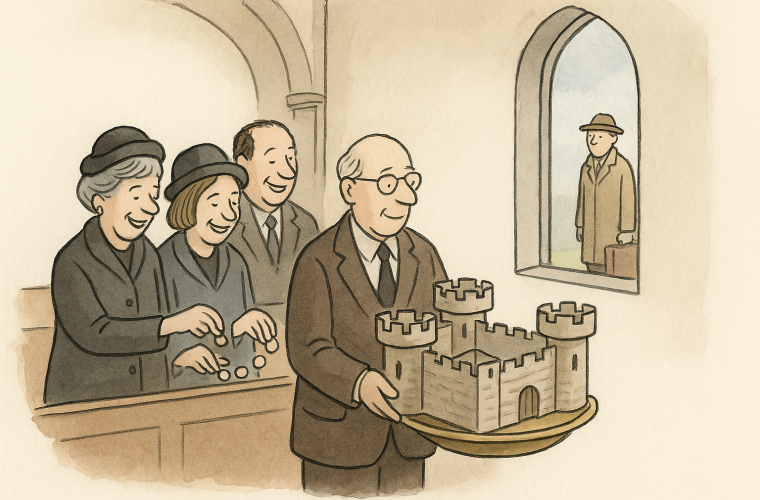
Picture the scene. A church hall somewhere in the shires, the kind with a draughty kitchen, a faint smell of instant coffee and a noticeboard groaning under jumble sale flyers. Someone has set out the plastic chairs in neat rows. And up at the front, beneath a banner of the Cross, a man is explaining — gently, reasonably, with a Bible verse loaded and ready — why your neighbour from over the water has to go.
This is the bit of British politics nobody quite wants to look at straight: the marriage of God and the gunboat. Reform UK has, of late, discovered Jesus. Not in any messy, road-to-Damascus, give-away-your-cloak sense, you understand. More in the manner of an estate agent discovering a property has “period features” the moment it suits the sale. Christianity, we are now told, is part of our heritage, our values, the very mortar of the nation. And what better way to defend that sacred inheritance than by making damn sure as few foreigners as possible get to share in it?
Now, I’ll grant you, there’s a temptation to treat this as a contradiction. The cuddly carpenter who told you to love your enemies, repurposed as a bouncer on the door of Fortress Britain. How does that work, exactly? You’d think the obvious response is to laugh, or weep, or both.
But here’s the thing. It isn’t a contradiction at all. It’s the oldest trick in the book.
The Good Samaritan, abridged
Everybody loves the parable of the Good Samaritan. It’s the one even the most aggressively lapsed among us can dimly recall: bloke gets mugged, left for dead in a ditch, the respectable types stroll past with their noses in the air, and then along comes the outsider — the Samaritan, the wrong sort, the man from the despised neighbouring tribe — who stops, binds the wounds, pays for the bloke’s lodgings and asks for nothing back.
The whole point of the story, the bit that made it dynamite two thousand years ago, is that the hero is the foreigner. The man you were taught to distrust turns out to be the only one with a shred of decency. It is, if you read it to the end, about as pro-stranger a story as has ever been told.
Which is precisely why the new disciples of border control never quite get to the end. They love the scenery — the dusty road, the wounded traveller, the warm glow of charity — and they very carefully shut the book before the punchline lands. Praise the parable, ignore the moral. It’s the theological equivalent of humming along to a protest song you haven’t listened to.
Render unto Nigel
Let’s not pretend this is new. Draping cruelty in the robes of righteousness is a craft with a long and distinguished history. Slavers quoted scripture. Empire-builders quoted scripture. Every workhouse beadle who ever turned away a starving family had a verse to hand and a clear conscience to match. There is no policy so cold that someone, somewhere, can’t find a holy text to warm it up.
The genius of it is the cover it provides. Say you want to deport people, and you’re a hard-faced opportunist chasing a poll bump. Say the same thing while clutching the Good Book, and suddenly you’re a humble defender of civilisation, a man burdened by sacred duty, more in sorrow than in anger. The deportation notice doesn’t change. The branding does. It’s the difference between a debt collector and a debt collector who’s found Jesus — the knock on the door is identical, but now he feels morally improved about it.
The American import
If you want to see where this is heading, look across the pond, because they’ve been at it for decades and they’ve turned it into an industry. The American Christian right doesn’t do subtle. Out there, the cynicism comes with a polish all of its own: cavernous mega-churches the size of out-of-town retail sheds, the pastor on the jumbotron working himself into a sweat, and — this is the genuinely modern touch — a scan-to-pay barcode bolted to every pew so the faithful can tithe by phone before the sermon’s even finished. Render unto Caesar, contactless. The collection plate has gone digital and the Holy Spirit takes Apple Pay.
And that machine, that great whirring engine of donation and broadcast, pours its money and its muscle into the right-wing project. It is, on the face of it, the same grift as ours, only louder and richer.
But here’s the wrinkle, and it’s worth pausing on. I’m not for a moment suggesting the American evangelicals are the same animal as our home-grown crowd — your Tommy Robinson pressing crosses into hands at a rally, your Laurence Fox with the cross inked onto his neck. That lot are cynics through and through; the Cross is a prop, a logo, a bit of theatre to rile the right people. The evangelical right, for all the barcodes, are something more dangerous. They actually believe. They are, by their own lights, righteous.
And that matters, because when the politics and the righteousness stop pulling in the same direction — when the party asks for something the faith can’t stomach — it is the faith that wins. Religion can swallow politics whole. The reverse never happens. A true believer will burn down the campaign for the sake of the creed before he’ll bend the creed to suit the campaign. Our cynics have no such ballast; they’ll drop Jesus the moment he stops polling. Which of the two is more frightening, I leave to you.
The convenient sort of Christianity
Here’s what gives our lot’s game away. This born-again border patrol is remarkably selective about which commandments it fancies enforcing. All the awkward stuff — the camels and needles, the moneylenders getting turfed out of the temple, the unambiguous instruction to welcome the stranger because you yourselves were strangers once — somehow never makes the manifesto. What survives is a kind of cultural Christianity, a Christianity of bunting and bell-towers and the King James cadence, drained of every inconvenient demand it ever made.
It is, frankly, faith as a flag rather than a faith. A bit like supporting a football club purely so you can sing about hating the other lot, without ever having watched a match.
Real religion is supposed to be a pain in the backside. It’s supposed to ask difficult things of you, to discomfit the comfortable, to drag you out into the cold to help someone you’d rather walk past. The version on offer here asks nothing of you at all except that you point your suspicion in the approved direction. That’s not a creed. That’s a marketing strategy with a steeple.
And so the collection plate comes round
None of this will trouble the architects, of course. They’ve got the perfect racket. Wrap the hard stuff in the soft language, quote the bit everybody likes, and bank the votes of people who genuinely believe they’re doing the decent thing.
My only suggestion, to anyone tempted, is modest enough. Next time a man with a Cross and a clipboard tells you that compassion means closing the door — read the parable. All of it. Right to the end. Because the man who stopped at the ditch wasn’t from round here either.