
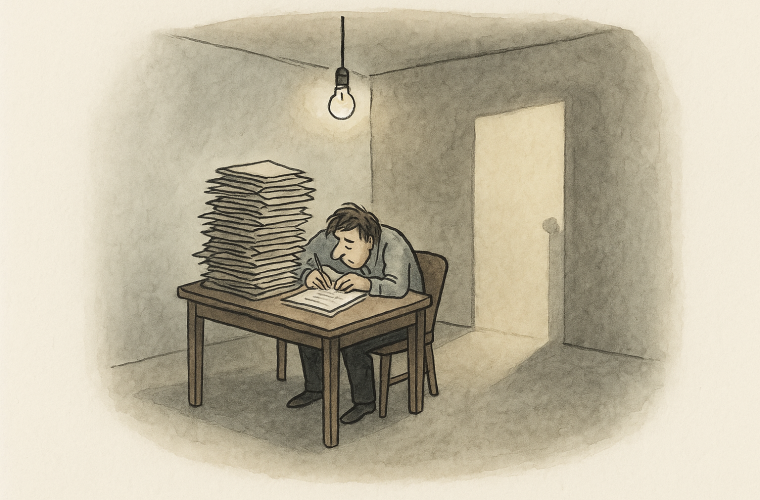
The email landed on a Tuesday. Bad news always picks a Tuesday. Marta read it twice before the words would hold still long enough to mean anything: the agency was “transitioning to AI-assisted workflows,” and her contract would not be renewed. Fifteen years of turning German legal contracts into English ones, gone in a paragraph that had, she noted with the grim eye of a professional, almost certainly been machine-drafted.
She expected to feel as though the floor had given way. What she actually felt, sitting at her kitchen table in Walthamstow with the kettle wittering away behind her, was something far more disconcerting. Relief. A great, daft, guilty wave of it.
This is the story nobody tells you about the machines coming for the work. We are sold two endings — the dystopia where everyone is jobless and despairing, or the techno-utopia where we all become artisanal cheesemakers fulfilled beyond measure. The truth, as ever, is muckier and far more interesting. For a certain kind of person, doing a certain kind of job, the redundancy letter wasn’t an eviction. It was an unlocked back door they’d been too sensible to open themselves.
The work that hollows quietly
Let’s be honest about translation, or at least the corporate variety. There is a romance to the word — Marta’s old university tutor used to bang on about being “a bridge between worlds,” which sounds splendid until you’ve spent your nine hundredth afternoon rendering indemnity clauses for a logistics firm. The bridge between worlds, it turns out, mostly carries paperwork.
There’s a particular cruelty to a job that is genuinely skilled and yet utterly devoid of nourishment. You can’t dismiss it as unskilled drudgery and feel righteous about your contempt. You’re good at it. People pay handsomely for your goodness. And every single day a little more of you quietly switches off, like the lights going out in an office block, floor by floor, until there’s just the one bloke on the fourth landing wondering where everyone went.
You don’t notice the hollowing while it’s happening. That’s the trick of it. It’s only afterwards, in the strange clear air of having nothing to do, that you realise how much of yourself you’d filed away under “sunk cost.”
Sideways, not down
Here is where the received wisdom gets it gloriously wrong. We imagine the displaced worker must either claw their way back to the same job by other means, or tumble down the ladder into something lesser. Reinvention is supposed to be a vertical business — up if you’re lucky, down if you’re not.
But the people who seem to come out of this best don’t go up or down. They go sideways. They take the actual skill — the thing underneath the job title — and bolt it onto something that the machine can’t be bothered with, because the machine has no reason to bother.
Marta didn’t become a translator again. She started teaching German conversation to a handful of older people in her neighbourhood, the sort who’d always meant to learn and never had a reason urgent enough. No contracts. No indemnity clauses. Just Tuesday evenings, a flask of coffee, and the genuinely thrilling spectacle of a 71-year-old retired postman ordering an imaginary beer in Berlin and getting the dative right. She earns less. She has, by her own cheerful admission, never been better company at dinner.
The machine took the part of the job that was data. It had no interest whatsoever in the part that was human, because humans are slow and expensive and prone to laughing at their own mistakes. And it is precisely that abandoned territory — the slow, the expensive, the human — where the escapees have pitched their tents.
Not a sermon
Now, I can hear the cynic at the end of the bar already, and he’s not wrong to pipe up. This is not a universal happy ending, and anyone selling it as one is a wrong’un. For every Marta there is someone with a mortgage and three kids who cannot afford to discover their bliss, who needed that salary and got a paragraph of corporate guff instead. Redundancy is a brutal business and dressing it up as liberation for everybody would be the sort of cheap sentiment that ought to get a person barred.
So let’s be precise. The point isn’t that losing your job to a machine is good. The point is that some jobs were already quietly killing the people doing them, and the machine merely got there first and put it in writing. The relief Marta felt wasn’t relief at the redundancy. It was relief at being released from a verdict she’d been too professional, too responsible, too British to deliver on herself.
The machines are very good at the things that can be measured. Words per hour. Cost per unit. Accuracy to the decimal. What they are hopeless at — and will, I suspect, remain hopeless at — is the question of whether a thing is worth a human spending their one finite life on it.
Marta worked that out on a Tuesday, at her kitchen table, with the kettle screaming behind her. It took a machine to tell her what every honest part of her had known for years.
Doing less, it turns out, was never the smaller life. It was just the braver one.