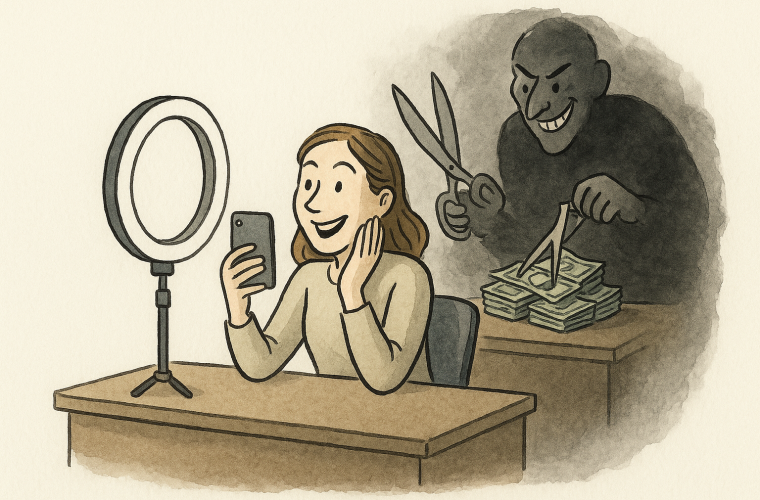
Somewhere right now, a woman in a flat in Salford is photographing herself under a ring light she bought on credit, and she genuinely believes she’s running her own business. Bless her, in a sense she is. She set up the account. She picked the angle. She came up with the cheeky caption. What she may not fully clock is that the bloke who slid into her DMs offering to “handle the boring stuff” — the messaging, the marketing, the so-called strategy — has quietly taken half of everything she earns. Half. Not a tenner here, not a finder’s fee. Fifty pence in every pound, in perpetuity, for the crime of typing flirtatious nonsense to strangers on her behalf.
Welcome to the gig economy’s grubbiest little corner, where the language of liberation has been bolted onto the oldest racket in the book.
The pitch is irresistible, which is precisely the problem. OnlyFans built its empire on a single, genuinely radical idea: cut out the studios, the publishers, the leering intermediaries, and let creators sell directly to their audience. Keep eighty per cent. Be your own boss. The platform itself takes a 20% cut and is upfront about it, which in this trade counts as almost saintly transparency.
So far, so empowering. Then the middlemen arrived, smelling money the way gulls smell chips.
The agency racket
They call themselves agencies. Management companies. “Creator collectives,” if they’ve been to a branding workshop. The websites are all soft pastels and stock photos of women laughing at salads, the copy stuffed with words like journey and brand and scale. What they actually do is take a cut of what the women earn for chatting to subscribers, posting on a schedule, and answering messages. A standard arrangement, by multiple accounts in the trade press, runs to a 50% split. Half. Gone.
Now, fair’s fair — some of these outfits do real work. They run the chat accounts round the clock, write the marketing, handle the tax. Genuine labour, genuinely outsourced. If a baker hires someone to run the till and they split the takings, nobody’s calling Scotland Yard.
But here’s where the smell gets ropey. The split doesn’t shift with the work. A woman pulling in serious money hands over the same fifty per cent as one barely scraping by, regardless of whether the agency lifts a finger beyond cashing the cheque. And the contracts — the ones that exist at all — have a habit of being long, vague, and weighted entirely one way. Exclusivity clauses. Penalties for leaving. The platform’s own terms forbid agencies from operating accounts without disclosure, yet the practice is widely reported to be rife. OnlyFans has stated it prohibits account management that breaches its terms. Saying it and stopping it are, as ever, two very different sports.
Pimping with a Wi-Fi connection
Let’s not be coy about what this resembles. You take a vulnerable worker, you control her access to the market, you take half her earnings for the privilege, and you make leaving difficult. Strip away the Squarespace template and the gender-studies vocabulary, and you’re left with a structure that would have been instantly recognisable to a man in a sheepskin coat standing on a street corner in 1974.
The genius of the modern version is the rebrand. The old pimp threatened. The new one mentors. He doesn’t take your money; he invests in your brand. He’s not exploiting you; you’re a girlboss and he’s merely facilitating your empowerment. It’s the same hand in the same till, but now it comes with a motivational quote and a ring light.
And the marks are, by design, the people least able to push back. A lot of these women are young. A lot are skint, which is rather the point — the recruitment patter leans hard on the promise of life-changing money, the way every dodgy scheme from timeshares to crypto has always leaned. Reports across the sector describe creators who didn’t fully grasp what they’d signed, who couldn’t get a straight answer on where their money went, who found the exit door mysteriously bolted. The standard tale of the worker with no leverage, told in a fresh dialect.
Whose problem is it, anyway?
Here’s the convenient bit for the platform. OnlyFans can stand back, point at its generous headline split, and insist the relationship between a creator and her “agency” is nothing to do with them. Two consenting parties. A private contract. Not our circus, not our monkeys.
Which is precisely the dodge that every gig platform has perfected. Build a marketplace, profit handsomely from the volume flowing through it, and then disclaim all responsibility for the predators it attracts, on the grounds that everyone’s technically self-employed. Deliveroo did it with riders. Uber did it with drivers. The wheeze is always the same: independence when it suits the balance sheet, abandonment when it doesn’t.
The word empowerment has taken a kicking this past decade, dragged out to sell everything from energy drinks to redundancy packages. But there’s something especially bleak about watching it deployed as cover for a 50% skim. Real empowerment would mean a woman keeps what she earns and walks away when she likes. What’s on offer instead is the feeling of being a boss while someone else pockets the wages — autonomy as a marketing aesthetic, sold back to the very people it’s busy fleecing.
The platform built a door out of the old exploitation. It just forgot to mention how many lads were waiting on the other side, clipboards ready, to walk the women straight back in.