
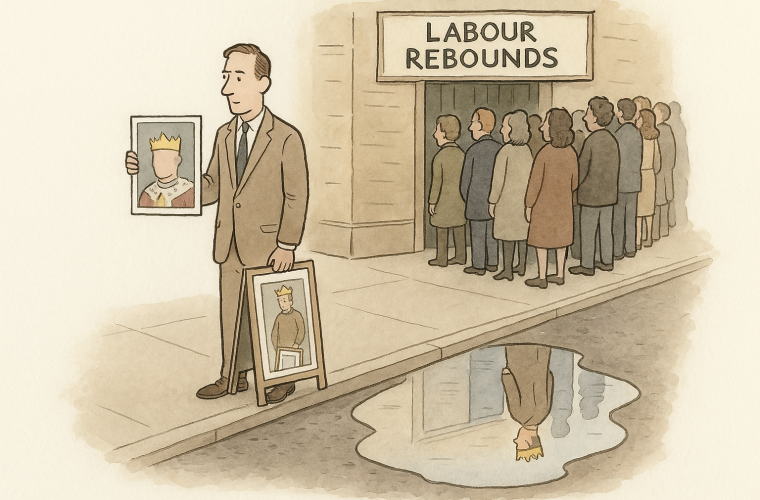
There’s a particular sort of pub conversation you only get to witness if you stay till closing. The bloke at the end of the bar, three pints deep, telling anyone within earshot about his brilliant new girlfriend. She’s nothing like the last one, he insists. Totally different. Then he describes her, and you realise she has the same haircut, the same job, the same withering way of looking at him when he forgets the milk. Different woman. Identical relationship. He’s not moved on. He’s just found someone willing to make the same mistakes feel fresh.
Labour, bless its restless heart, is having exactly this conversation with itself about Andy Burnham.
The whispers have been doing the rounds for months. The party that won a landslide barely a year ago is already glancing wistfully out the window, wondering if the grass might be greener with a different fella up front. And the name that keeps floating up through the froth is the Mayor of Greater Manchester, the so-called King of the North, the man who fancies himself the keeper of Labour’s lost soul.
Here’s the thing nobody at the bar wants to admit. Burnham isn’t the upgrade. He’s the rebound.
The ex you swore you’d never go back to
Let’s be honest about what the swooning is really about. Westminster Labour looks at Burnham and sees an antidote to the current management’s allergy to having a personality. He’s got the Mancunian accent, the open collar, the air of a man who’d actually buy his round. He says words like “community” and “dignity” without sounding like he’s reading them off a card held up by a focus group.
And that’s the trick of every rebound. It scratches precisely the itch the last relationship left raw. Where the current lot feel managerial, Burnham feels human. Where they feel like they’re apologising for existing, he feels like he believes in something. The contrast does all the work.
But squint a little and the resemblance to the ex starts to creep in. Because the last time Labour fell hard for a man promising to restore its soul — to drag it back to its proper northern, plain-speaking, sod-the-establishment roots — we all know how that went. The party spent the better part of a decade learning the difference between a movement and a wake.
Burnham isn’t that man, not exactly. He ran against that man, twice, and lost. But the emotional logic is identical. The pull is the same pull. It’s the fantasy that the answer to your troubles isn’t doing the hard graft of being a better partner — it’s finding someone new who makes you feel the way you did before it all went pear-shaped.
Similar enough to scratch the itch
What makes a rebound dangerous isn’t that it’s a clean break. It’s that it’s a disguised repeat. You tell yourself you’ve grown, you’ve learned, you’re choosing differently this time. And you have — just enough to believe the story. The new one is more electable than the old firebrand. More grounded. Less prone to wandering off into ideological cul-de-sacs while the country gets on with hating you.
Different enough to pretend you’ve grown as a person.
But the underlying want hasn’t shifted an inch. It’s still the same craving for a saviour, the same allergy to the boring business of governing, the same conviction that the problem was never the policies or the discipline but the vibe. Labour doesn’t want to fix its marriage to power. It wants the dopamine hit of a fresh face who makes the old feelings come flooding back without the baggage.
That’s not growth. That’s a bloke at the bar describing his ex and calling her someone new.
The catch nobody mentions
There’s a small, inconvenient detail in all this longing, which is that Burnham isn’t actually an MP. He runs a city, rather well by most accounts, from a building several hundred miles from the green benches where this fantasy would have to be consummated. To lead the parliamentary party, he’d first need a seat, which means a by-election, which means a sitting member volunteering to fall on their sword for the good of the rebound. The logistics of the affair are, shall we say, awkward.
Which rather suits the whole metaphor, doesn’t it? The rebound is always more appealing in the imagining than in the doing. In the head, it’s all open collars and renewed purpose. In practice, it’s a thousand tedious arrangements and the slow dawning realisation that you’ve brought all your old problems along for the ride, just dressed in a Manchester accent.
The trouble with rebounds is the morning after. You wake up, the giddy contrast has worn off, and you’re left looking at the ceiling, working out that the thing you were running from was never the other person.
It was you.
Labour can change the face at the front as often as it likes. But until it works out what it actually wants from being in power — beyond the warm glow of feeling like the good guys again — every new romance is just the old one with a fresh haircut. The King of the North can return all he wants. The kingdom’s the same shambles he left.