
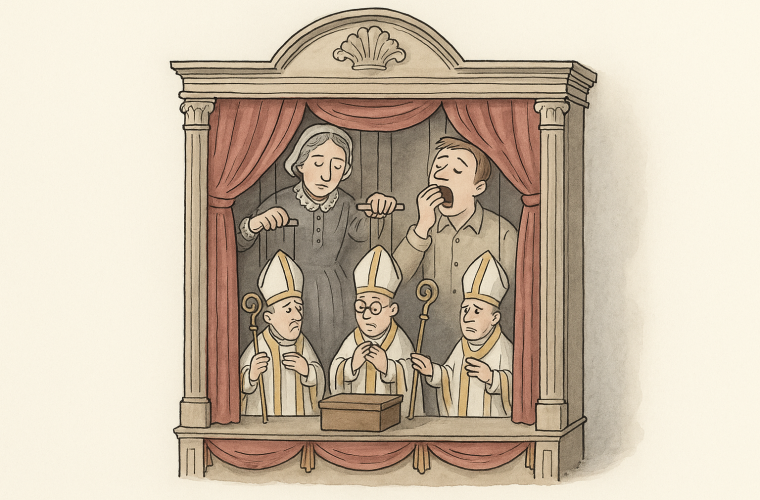
Somewhere in Bedford — and the exact address is, appropriately, none of your business — there sits a sealed wooden box. It has been waiting for over two hundred years. The box belongs to a charity with assets totalling £23 million, a Victorian campus that has been turned into a rather good free museum, and a fully operational research centre at the University of Cambridge. It is, by any measure, one of the most elaborately administered boxes in British history.
The Church of England has never opened it. The Church of England has never tried. And on the available evidence, the Church of England is not planning to start any time soon.
This is the story of the Joanna Southcott box. It is also, if you look at it squarely, the story of an institution so paralysed by the fear of looking foolish that it has spent two centuries refusing to look inside a box — while the people who built the box quietly got on with building an empire.
—
Joanna Southcott was born in Devon in 1750, a domestic servant who became, in middle age, one of the most improbable prophets in English history. By the time of her death in 1814, she had, by contemporary estimates, approximately a hundred thousand followers and a claim that she was pregnant with the Shiloh, a new Messiah, despite being sixty-four years old. The pregnancy turned out to be phantom. The followers did not. They rationalized the failure, as people always do, and pressed on.
What Southcott left behind, besides the followers and the theology, was a box. A sealed wooden casket of prophecies, with conditions attached: it was to be opened only during a time of national crisis, in the presence of all twenty-four bishops of the Church of England, who were first to spend a period studying her writings. It was, in effect, a standing appointment she had made with the entire episcopal bench, to be honoured whenever things got bad enough.
Things have been bad enough rather a lot since 1814. The Crimean War, for instance. Two world wars. The three-day week. Brexit. A pandemic. Three prime ministers in as many months. Not one of these has been judged, by the Church of England, to constitute sufficient national crisis to merit sitting down with a box.
—
To be fair — and fairness is a virtue, even here — someone did have a go in 1927. A psychic investigator named Harry Price claimed he had been sent the authentic box, x-rayed it for public interest, and then opened it in the presence of the Bishop of Grantham. Not twenty-four bishops. One. A suffragan, which is to say a bishop of the supporting rather than the headline variety. He found inside a dice box, a pair of earrings, a sleeping cap, a horse pistol, a calendar, some coins, a metal puzzle, and a lottery ticket.
The Panacea Society — the Bedford-based organisation that by this point had taken stewardship of the movement — immediately declared that Price’s box was not the authentic box. The real one, they said, was with them. It still is. The bishops, having been made to look like the mugs they feared they would, were even less inclined to try again.
One Archbishop of Canterbury, in correspondence that has been widely reported, described the proposition of twenty-four bishops assembled around Southcott’s casket as “partly profane and partly comic.” He did not say which part worried him more.
—
Here is what the Church of England’s caution has cost it, by way of contrast with what the Southcottians got up to while the bishops declined to engage.
Mabel Barltrop, a Suffolk vicar’s widow who had been sectioned for melancholia after her husband’s death and who subsequently emerged declaring herself Octavia, daughter of God, founded the Panacea Society in Bedford around 1919. She attracted a community of disciples — largely, according to historical accounts, wealthy widows and spinsters, who moved into houses near her headquarters on Albany Road. By the time the society peaked, it owned around thirty properties in the town. Bedford was, according to Octavia, the original site of the Garden of Eden. The River Great Ouse, presumably, was the Euphrates. This is the sort of claim that the Church of England finds comic. The Church of England is also not sitting on a thirty-house Bedford portfolio.
In the 1960s and 1970s, the society ran a national advertising campaign — billboards, the Sunday Express — with the slogan: “War, disease, crime and banditry, distress of nations and perplexity will increase until the Bishops open Joanna Southcott’s box.” The bishops, according to available records, made no reply. The society went back to managing its property portfolio.
The last member of the Panacea Society died in 2012. The organisation became a secular charity — the Panacea Charitable Trust — with, according to reporting by Frances Stonor Saunders in the Guardian, a long-term investment portfolio of £20 million and a further £3 million in assets. This money now funds, among other things, the Centre for the Critical Study of Apocalyptic and Millenarian Movements at the University of Cambridge, which publishes a peer-reviewed online encyclopedia covering everything from medieval Flagellants to contemporary AI extinction anxiety. You can visit the Panacea Museum in Bedford for free. The Victorian campus is immaculate.
—
The box, as far as anyone knows, is still in Bedford. It is still sealed. The conditions have not changed: twenty-four bishops, a time of national crisis, a period of prior study.
The Church of England, which has spent two centuries finding this arrangement partly profane and partly comic, is presently dealing with declining attendance, disputed doctrine, and a general cultural retreat that makes even its most optimistic members a little nervous about the medium term. The Panacea Charitable Trust has assets totalling £23 million and a Cambridge research centre funded to 2029.
Who exactly is the credulous party here is, at this point, a question a bishop might want to think about. Perhaps while sitting very still in front of a wooden box, with twenty-three colleagues. There is precedent. There is even, technically, an appointment.
The box is patient. It has been patient before.