
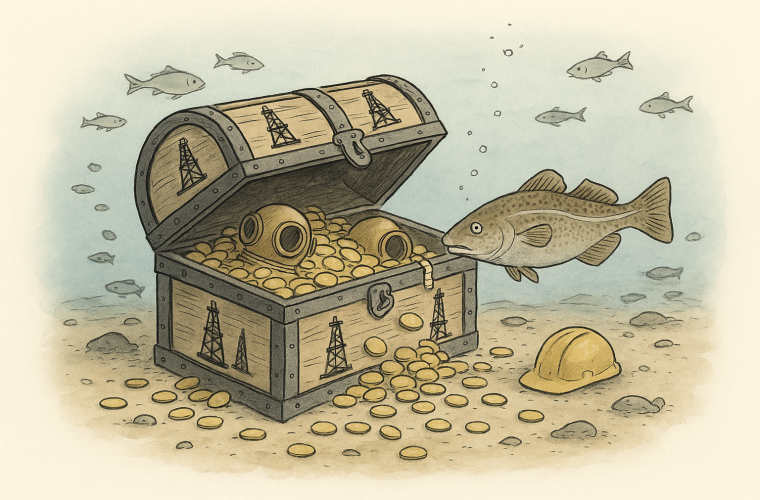
The North Sea has swallowed a great deal in its time: Doggerland, the herring fleet, roughly one national energy strategy per parliament. Its latest acquisition is rather pricier per kilo. Somewhere in the waters west of Shetland, a piece of kit destined for Rosebank — the largest undeveloped oilfield left in British waters — has reportedly gone over the side during installation. The upshot: months of delay to the project that was supposedly going to rescue Britain’s energy security. Not stopped by protesters. Not stopped by judges. Stopped by gravity.
Rosebank deserves a moment of context, because the industry has spent years dressing it up as the crown jewels. The field holds an estimated 300 million recoverable barrels and is operated by Equinor, Norway’s state-backed oil champion — a firm that drills in our waters and banks the dividends in Oslo — with Ithaca Energy holding the minority stake. The Conservatives waved through its consent in September 2023, to much fanfare and a fair bit of shouting. Then, in January 2025, the Court of Session ruled that approval unlawful, on the not unreasonable grounds that nobody had bothered to assess the emissions from actually burning the oil. So the project was already legally becalmed before anyone managed to fumble the hardware into the drink.
That’s the bit that elevates this from setback to farce. The offshore lobby has spent years assuring us that its opponents are naive students who don’t understand engineering, and that the grown-ups — the ones with the hard hats and the spreadsheets — should be left to get on with it. Then the grown-ups dropped the equipment in the sea. It’s the builder who spends six months banging on about his craftsmanship and his City & Guilds, then puts your new bath through the ceiling. You don’t doubt he can do the job. You just wish he’d stop telling you how good he is while the water’s coming through the light fitting.
The money makes it funnier still, in the bleak way these things are funny. The £30bn attached to Rosebank is the industry’s own valuation of the project’s worth to the nation — a number produced by the people selling the project, marked by their own homework monitor, and repeated by politicians who couldn’t tell you what’s in it. You could build a respectable number of hospitals with £30bn. You could also, it turns out, dangle a chunk of it off the back of a boat.
And what has the lobby done in response? Has it gone quiet for a decent interval, the way you or I might after reversing the works van into the client’s greenhouse? Has it heck. By all accounts the pressure is now on Andy Burnham to smooth Rosebank’s path: warm words, expedited consents, and ideally a fiscal sweetener to make the delay sting a little less. The word ‘bailout’ will not appear in any briefing document, naturally. It never does. The logic, as ever, is that the project is too important to fail — a curious argument to advance in the same breath as explaining why it’s currently sitting on its hands because somebody dropped the important bit.
This is the North Sea model in miniature, and has been for decades. When the oil flows, the profits are private, the dividends sail abroad, and any suggestion of a windfall levy is treated as Bolshevism with a clipboard. When something goes wrong — a delay, a downturn, a field wheezing towards the end of its life — the begging bowl comes out and the taxpayer is invited to steady the ship. The National Audit Office has already put the public cost of decommissioning tax reliefs in the tens of billions. Heads they win; tails we pay for the funeral.
None of which means Rosebank won’t eventually get built. It probably will, in some form, once the courts, the consents and the cranes are all pointing the same way. The industry has deep pockets, deeper lobbying budgets, and a well-rehearsed line about jobs and security that plays in any constituency with a heliport. But the next time a bloke in a branded fleece tells you that only the serious people can be trusted with Britain’s energy future, remember what the serious people actually delivered to the seabed this year.
Because as things stand, the UK’s biggest undeveloped oilfield has produced no oil, no gas and no security — just one very expensive artificial reef. The cod, at least, are ahead on the deal.