
Under British tax law, a bribe is income. Declare it, pay your marginal rate, and HMRC will bank the proceeds without so much as a raised eyebrow. The principle is Victorian: in 1886 the courts decided that a pair of bookmakers running an illegal betting operation still owed tax on the takings, and the logic has held ever since. Crime, as far as the Revenue is concerned, is a trade like any other, and trades get taxed. HMRC’s own Business Income Manual spells it out. The taxman does not moralise. He invoices.
There is something almost admirable in that cold-bloodedness — a state so ruthlessly indifferent to how the money was made that it will take its slice of a backhander with the same serenity it applies to a plumber’s VAT. Admirable, that is, if the machine pointed both ways. It doesn’t. It points, with laser precision, at you.
Other countries push the logic in stranger directions. Finland, for instance, taxes ordinary gifts: let a generous aunt hand you more than a few thousand euros over three years and the Finnish taxman wants his cut, no wrongdoing required. Even Helsinki has its blind spot, mind — pay a bill on someone’s behalf and it doesn’t count. Slip your nephew the cash for his rent and he owes gift tax; pay the landlord directly and nobody owes a bean. Every tax system has a quirk like that baked into it. Ours is that the enforcement machinery only faces one direction.
And which direction is that? Consider what the Public Accounts Committee found when it went rummaging through HMRC’s enforcement record earlier this year. According to the committee’s report, the department could not point to a single prosecution in five years of the professional enablers of offshore tax evasion — the accountants, advisers and assorted fixers who design the schemes, draft the paperwork and take a fat fee for making other people’s money vanish. Not one. Five years. The people who build the getaway cars have had a quieter half-decade than a rural post office.
It gets better, in the way that food poisoning gets better before it gets worse. The Criminal Finances Act 2017 created a shiny new corporate offence of failing to prevent the facilitation of tax evasion. It was launched with the usual ministerial fanfare — a new era of accountability, the big firms finally on the hook. The Public Accounts Committee noted the running total of companies charged under it: zero. The law has spent eight years on the statute book doing roughly what a chocolate teapot does, which is look reassuring on the shelf while performing no function whatsoever. And this while evasion costs the country at least £5.5 billion a year by HMRC’s own tax gap estimate — a figure the committee suspects is generously understated, since the department shows all the investigative curiosity of a man who has decided he’d rather not know what’s in the attic.
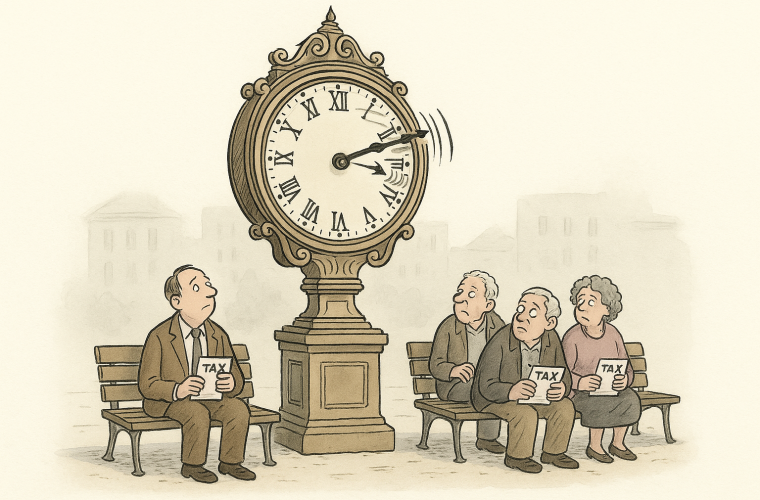
Now turn the telescope round and look at the other end of the enforcement pipeline. Every January, roughly a million people miss the self-assessment deadline, per HMRC’s own annual tallies, and the machine swings into action with a speed it never manages for anyone with a Liechtenstein foundation. Miss the deadline by a day and it’s £100, automatically, no human hand involved. Owe no tax at all? Doesn’t matter. The fine isn’t for depriving the Exchequer of money; it’s for depriving it of a form.
And it doesn’t stop at a hundred quid. Leave it three months and the meter starts running at £10 a day. Leave it longer and the pile can climb towards £1,600 — for a return on which, let us say it again, the tax owed may be precisely nothing. Research by the campaign group Tax Policy Associates, digging through HMRC’s own penalty data, found tens of thousands of these fines — the pitch that landed this piece on the desk put the figure at 95,000 in a single year — falling on people who were late, skint, or simply bewildered by a system that enrolled them in self-assessment they didn’t know they needed. Carers. Pensioners. Blokes who did three weeks of cash-in-hand delivery driving in 2021 and never heard the end of it.
Why does it work this way? Because the economics are irresistible. Fining the compliant is cheap. A computer prints the letter, the letter frightens an honest person, the honest person pays. Job done, target met, everyone home by five. Prosecuting an enabler, by contrast, means years of work against a defendant with a KC on retainer and a filing cabinet full of plausible deniability. One of these activities makes HMRC’s numbers look busy. The other makes them look like they’ve lost.
It is the enforcement philosophy of a nightclub bouncer who waves through the lads with knuckledusters — too much aggro, that lot — and spends the evening frisking pensioners for boiled sweets. The door policy looks rigorous. The count of people searched is excellent. The club, meanwhile, is on fire.
HMRC’s defence, when pressed by the committee, was the usual litany: resources, complexity, the difficulty of meeting the criminal standard of proof. All true, and all beside the point. Difficulty is the job. A tax authority that only pursues the easy cases isn’t enforcing the law; it’s harvesting the docile. The £100 penalty exists because the people who receive it will pay it. The enabler walks because he won’t.
So here is the state of play in modern Britain. Take a bribe, and the law says the taxman is owed his cut — in principle, solemnly, going back to 1886. In practice, don’t wait up. He’s busy. Somewhere out there is a widow whose paperwork arrived three days late, and unlike you, she’ll actually pay.