
Picture the two places at once. A back street in Bradford in the 1940s, all soot and thrift and a long way from anywhere. And a flat blue swimming pool in the Hollywood Hills, the most Californian thing imaginable, painted by the boy who grew up in the first. David Hockney, who died this week at 88, spent a career holding those two images in the same frame. The obituaries, quite rightly, are full of the pools and the colour and the iPad in old age. But the most extraordinary thing about Hockney was never the work. It was the distance.
Here is the distance, made into a number. In 2018, his “Portrait of an Artist (Pool with Two Figures)” sold at Christie’s in New York for $90.3m, around £70m. At the time it was the most ever paid at auction for the work of a living artist, edging past a giant steel balloon dog. A working-class lad from Bradford, born in 1937, had become, for one night in Manhattan, about as valuable as a living painter gets. You can admire the talent all you like, but talent is not the rare thing here. The rare thing is the journey.
Think about who else makes it. The escape velocity Hockney achieved, bottom of the heap to the very top on ability alone, is something we now reliably see in only two places: the professional football pitch and the recording studio. A kid from a tough estate can still, occasionally, run or sing his way out. Almost everywhere else, the doors have quietly swung shut. Which is what makes Hockney less a one-off genius than a kind of fossil: proof that a certain route up the British mountain once existed, preserved in amber.
Because it did exist, and he is the evidence. Hockney climbed at the precise moment the climbing was easiest. He went through the Royal College of Art and out into the world in the early 1960s, on the up-escalator of the postwar settlement — the grammar schools, the maintenance grants, the art colleges that cost a clever poor child little more than the nerve to turn up. It was the one stretch of British history deliberately engineered to let talent travel regardless of the bank balance it was born into. And the official figures bear it out: of creative workers born between 1953 and 1962, 16.4% came from working-class backgrounds. Not a utopia. But a door genuinely ajar.
Now look at the same door today. According to those official figures, that 16.4% has fallen to 7.9% among people born four decades later — the working-class presence in the arts roughly halved within a single lifetime, Hockney’s lifetime. The Sutton Trust puts numbers on the squeeze from the other direction: a young person from a working-class background is four times less likely to end up in the creative industries than a middle-class peer. The same Sutton Trust work finds sixty-nine per cent of people in creative jobs now hold a degree, against 29% of the workforce at large; and a degree, these days, is rarely a thing you pick up for the price of turning up.
This is the part where the weary realist is obliged to be fair to both sides, and there is a case for the defence. Hockney himself would have had no time for a lecture about structures; he believed in looking harder than anyone else in the room, and in work. Plenty of forces beyond government conspired to narrow the path: the brute economics of a city flat, the collapse of the idea that an art degree leads anywhere that pays a mortgage. Nobody sat in a committee room and voted to keep the next Hockney in Bradford. Mobility did not so much get abolished as quietly priced out, which is a different and less satisfying villain.
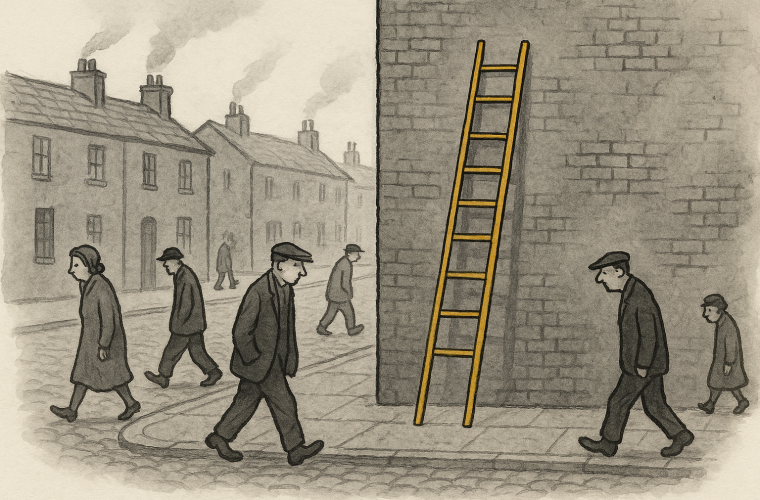
And yet the arithmetic is the arithmetic. The ladder Hockney climbed has, by most accounts, had several of its lower rungs removed, and the people who notice least are generally the ones already standing near the top. The result is an art world that talks endlessly about representation while drawing its talent from a narrower and narrower seam: privately educated, comfortably cushioned, fluent in a confidence that money quietly buys. A culture can do that for a while. It tends, eventually, to start producing work that only flatters the people who can afford to make it.
So what does Hockney’s life tell us about social mobility? Two things, and they sit awkwardly together, which is rather the point. The first is hopeful: it can be done, it has been done, the distance from a Bradford terrace to a record-breaking wall in Manhattan is not infinite. The second is sobering: he did it on a settlement we have spent forty years dismantling, and the numbers suggest his kind of journey is now roughly half as likely as it was the year he set off.
We will hang his pools in the great galleries and call him a national treasure, which he was. The more honest tribute would be to notice that the country which produced him has done rather little to ensure it produces more like him. He gave us a bigger splash. We have handed the next one a shorter ladder, and then we wonder why so few of them reach the water.