
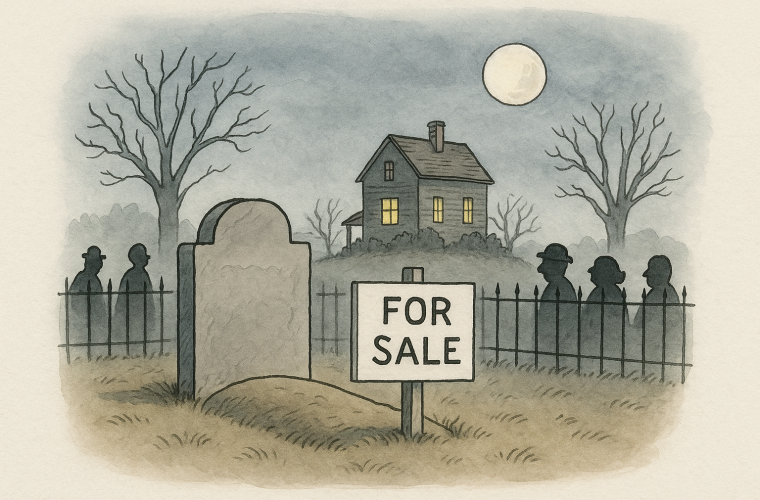
“As a matter of law, the house is haunted.”
That is not a line from an M.R. James story, nor the tagline of a straight-to-video horror. It is the actual holding of the Appellate Division of the New York Supreme Court, First Department, delivered in 1991 in Stambovsky v. Ackley — a judgment that has been making first-year law students snort into their casebooks ever since, and which remains, as far as anyone can tell, the only occasion on which a common-law court has certified a poltergeist.
The facts, as set out in the published opinion, are these. Jeffrey Stambovsky, a Manhattanite, agreed to buy a rambling Victorian in Nyack, a village up the Hudson, and put down a deposit — reportedly $32,500 against a purchase price of $650,000, according to contemporary press coverage of the case. Only afterwards did he discover that the vendor, Helen Ackley, had spent years cheerfully telling anyone with a notebook that the place came with resident spirits. She had recounted her family’s encounters with poltergeists in Reader’s Digest back in 1977, and again in the local press. The house had even featured on a five-home walking tour of Nyack, described in a 1989 newspaper article — quoted in the court’s opinion — as “a riverfront Victorian (with ghost).”
Stambovsky, being from the city and unversed in Rockland County folklore, knew none of this when he signed. When he found out, he wanted his money back. Ackley and her estate agent shrugged: caveat emptor. Buyer beware. New York law at the time imposed no general duty on a seller to disclose much of anything, and the trial court duly threw the claim out.
The appeal is where it gets good. By a three-to-two margin, the Appellate Division reversed and allowed Stambovsky to seek rescission of the contract. Justice Israel Rubin, writing for the majority, reasoned that caveat emptor rests on the buyer’s ability to inspect the premises — and no surveyor, however diligent, is going to turn up a spectre behind the damp course. More to the point, Ackley had herself created and nurtured the house’s haunted reputation, dined out on it publicly for years, and could hardly now stroll into court and deny it. She was, in the legal jargon, estopped. And so, as between these parties, the house was haunted as a matter of law. Whether it was haunted as a matter of fact, the court sensibly declined to say.
Rubin plainly knew exactly what he had on his desk and was not about to waste it. The opinion notes that under a strict application of caveat emptor the plaintiff “hasn’t a ghost of a chance,” but that the court was nonetheless “moved by the spirit of equity” to grant relief — and it tips its wig to Ghostbusters, then still fresh in the cultural memory, along the way. One suspects the drafting took longer than the deliberating. The two dissenting judges were rather less amused, taking the view that caveat emptor should stand, that Ackley had made no misrepresentation to this particular buyer, and that carving out exceptions for the supernatural was an invitation to mischief. A fair point, if a joyless one.
It would be easy to file the whole thing under judicial whimsy and move on, but the ruling is quietly load-bearing. Strip out the ectoplasm and Stambovsky is a case about disclosure: what a seller must own up to when a defect — structural, legal or reputational — is invisible to even the most conscientious buyer. American lawyers still cite it in disputes over “stigmatised” property, the houses where something dreadful happened that no survey will ever reveal. And it has become a fixture of American law-school casebooks, the reliable moment of levity in an otherwise punishing term of contract doctrine — proof that even property law occasionally permits itself a laugh.
A British reader might feel a flicker of smugness here, given that English conveyancing has been steadily tightening its disclosure expectations for years, with sellers now routinely quizzed about disputes, flooding and the neighbours. But let’s not get carried away. Anyone who has bought a house in this country knows the process still runs chiefly on optimism, a surveyor’s hedge-everything prose, and the fervent hope that the vendor is not hiding anything worse than a dodgy boiler. Whether an English court would ever declare a cottage in the Cotswolds haunted as a matter of law is, mercifully, untested. One rather hopes some enterprising litigant tries.
As for the principals: Stambovsky got his escape route, Ackley kept her house and her ghosts, and Nyack acquired a piece of legal folklore considerably more durable than the walking tour. The poltergeists, if they exist, have never commented — and being unnamed, unserved and presumably beyond the court’s jurisdiction, they were under no obligation to.
Which leaves the state of the law in one narrow corner of New York exactly where Justice Rubin left it three decades ago. The courts of the Empire State take no position on whether ghosts are real. But if you spend twenty years telling Reader’s Digest that yours are, don’t expect a judge to let you exorcise them at the exchange of contracts. The spirits, it turns out, are binding.