
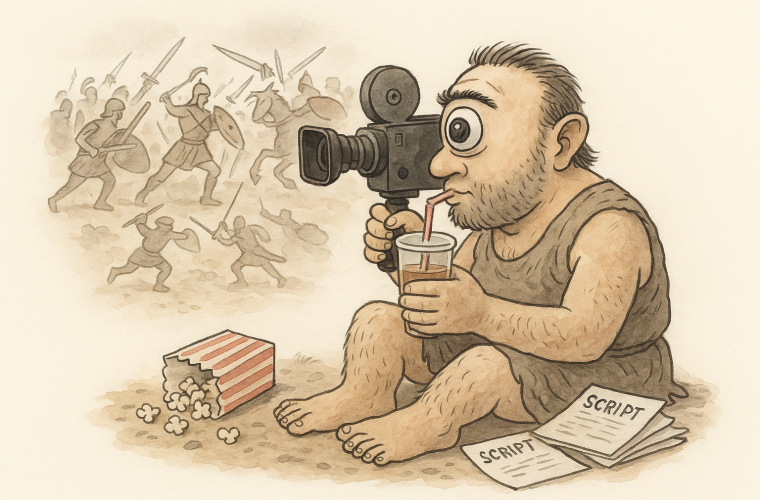
Here is an allegation to savour: the Coen brothers, it is said, made O Brother, Where Art Thou? — a film they openly billed as their interpretation of the Odyssey — without ever actually reading the thing. And honestly, why would they need to? This is arguably the most reused plot in history. The man and his journey. It is in our cultural bloodstream whether we have read a word of Homer or not.
My own Homer, for the record, is Stephen Fry’s — his immensely readable Odyssey, the final part of his superb retelling of the Greek myths. Emily Wilson’s lauded translation sits on my shelf, barely a page in, because if I start a book I feel compelled to finish it, and the Odyssey is not one book: it is twenty-four wrapped into a single volume. In narrative terms that means a lot of great set pieces to choose from. The stories are epic. And now, thanks to Nolan, we have the IMAX epic to weave an interpretation from.
And what an undertaking it is on paper. This is a 172-minute, R-rated, $250 million adaptation — the first feature ever shot entirely on IMAX cameras, filmed over 91 days across Morocco, Greece, Italy, Iceland, Scotland and the United States, and Nolan’s first release since Oppenheimer, which won multiple Academy Awards including best picture and best director.
Nolan has been open about his sources. Asked which translation he had in mind, he told Empire: “I think it’s the Emily Wilson translation that begins, ‘Tell me about a complicated man'”. Very well — but if portraying a complicated man was the ambition, why put Matt Damon in the lead? And that, I felt, was the point. Others have circled the same question: NPR’s critic reckoned “Damon is a fine actor, but he’s not your go-to guile guy”, arguing the role has been rebuilt around him. The casting is the interpretation.
Because the Odyssey is full of mythology, fantasy and a level of far-fetchedness that makes it silly to try to put it all in one film. You take the best bits, the essences here and there, pull them together into a story and punctuate the narrative with frequent “I need to get home”-isms. Nolan manages to fit most of it in whilst skipping, a little, the deus ex machina bits — though in the opening forty-five minutes we could actually have done with some of that. But the action gets going and soon we are in the Cyclops’s cave — a tale amazingly retold in Fry’s version, and handled here with judgement: Nolan knows when it is fine to play with the fantasy and when not to stretch it too far. This is a big-screen epic, after all. Action speaks louder than words.
Speaking of words: the accent of this movie is American. It does not matter the accent of the actor — Himesh Patel, Tom Holland — this is a Yankee retelling of the Odyssey, dodging the usual cinematic-classics habit of handing everyone an English accent the moment the text turns Shakespearian. PhillyVoice noted that Nolan uses modern language and avoids overly fancy dialogue and British accents in his interpretation — so at least the choice is deliberate.
At almost three hours it is a commendable stretch. I usually play a parlour game with movies of spotting the midpoint, but over this length Nolan seems more considered of the pacing, without any serious adherence to storytelling tropes and beats. The critical weather, for what it is worth, is broadly set fair: Rotten Tomatoes’ consensus credits the film’s “majestic sweep” and its colossal ensemble, whilst Screen Daily found the spectacle “not always as nimble emotionally or thematically” and others have queried the non-linear storytelling.
So, the verdict comes in three sizes. If you have never heard of the Odyssey and are unfamiliar with its tales, you will find an enjoyable epic of the kind only Nolan can get away with making in this day and age. If you are a lover of the classics, the Americanisation will grate — I mean really grate. And if you are a purist, a lot of this will simply frustrate you. But put all of that to one side and you will enjoy it. Set the expectation accordingly: this is just another retelling of the Odyssey — done ridiculously well, and worth every one of its three hours in a cinema, on the biggest screen you can find.