
Minus 24.9 decibels. Not zero. Below zero — a threshold so far past ordinary silence that the number itself feels like a typo. That is the reading logged inside the anechoic chamber at Orfield Laboratories in south Minneapolis, a figure certified by Guinness World Records and cited across coverage of the room over the years. To put it in terms a Londoner might grasp: a quiet bedroom at night hums along at around 30 decibels. This room sits some fifty-odd decibels beneath that, in territory where the human ear runs clean out of things to hear from the outside world and, in desperation, starts listening inward.
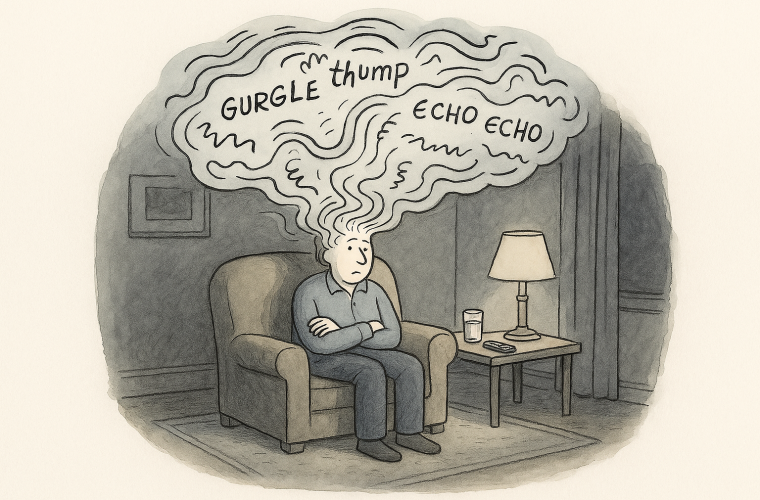
And here is the delightful, slightly grotesque punchline. Strip away every external sound and you do not get peace. You get yourself — turned up to eleven. Visitors report hearing their own heartbeat thumping like a bass bin, the whoosh of blood shunting through vessels, the gurgle and groan of an organism that has, until this precise moment, been decent enough to keep quiet about its plumbing. The claim that people can hear their own eyeballs shifting in their sockets has become the room’s signature party trick, repeated in accounts of the chamber for years. Whether that is literal biology or the mind filling a terrifying vacuum, the effect is the same: you become the loudest thing in the room, and you never asked for the gig.
Sound goes to die here
The engineering is properly clever, and worth savouring. An anechoic chamber — “an-echo-ic,” without echo, the clue is in the name — is built to eat sound rather than bounce it. Orfield’s version is a room within a room within a room: layers of insulated steel and concrete to keep the world out, and interior walls bristling with fibreglass acoustic wedges that trap incoming sound waves and refuse to give them back. There is no reverberation because there is nothing for the sound to ricochet off. Your voice leaves your mouth and simply… vanishes, like a striker’s shot swallowed by the top corner with no net to rustle.
Steven Orfield, who founded the lab, has spoken over the years about how disorientating the experience becomes. The commonly cited detail is that the longest anyone is reported to have managed alone in the pitch-black chamber is around three-quarters of an hour, and that most visitors ask to be let out well before that. Half an hour in the dark, according to accounts of the room, is enough to leave a person struggling to keep their balance.
Why would silence topple you? Because the brain is a magnificent freeloader. It uses ambient sound — the faint reflections bouncing off walls, floors and furniture — as a kind of sonar to orient the body in space. Take that away and one of your navigational instruments is quietly unplugged mid-flight. You start to sway. You reach for a wall that gives no acoustic clue it exists. It is less a spa treatment than a controlled existential wobble.
Fit for the void
Here is where the story lifts from novelty to something genuinely stirring. This is not merely a booth for thrill-seekers and journalists hunting a headline. The chamber does serious work. Manufacturers use rooms like it to measure exactly how loud their products are — the precise whir of a heart valve, the hum of a phone, the click of a switch — because you cannot engineer quiet into a device until you can hear it with brutal clarity. It is the acoustic equivalent of a photographer’s darkroom: you need the absence of one thing to see another properly.
And then there is the part that makes the hair stand up. NASA has reportedly used the space to help prepare astronauts for the profound sensory deprivation of space — the disorienting quiet, the loss of the ordinary background hum that keeps us tethered to reality. Think about the sheer human audacity of that. Before you send a person into the most silent place imaginable, the void beyond the sky, you first send them into the most silent place on Earth to see whether they can keep their marbles. It is the ultimate away fixture, and this room in Minneapolis is where they hold the training session.
The sound of being alive
What I love about all this is the beautiful inversion at its heart. We spend billions chasing quiet — noise-cancelling headphones, double glazing, the mindfulness app whispering that we simply must find our calm. We treat silence as the promised land, the thing forever out of reach in a city that never shuts up. And here is a room that delivers the real McCoy, absolute pin-drop nothing, and the overwhelming human response is to bang on the door and beg to be released back into the racket.
Because it turns out we do not actually crave silence. We crave a manageable amount of sound — the reassuring proof that the world is still turning and we are still in it. Perfect quiet is not serenity. It is confrontation. It hands you, unfiltered and inescapable, the one voice you can never turn down: your own pulse, insisting you are still here.
There is a hard-won bit of wisdom buried in that fibreglass. All this cleverness, all this engineering marvel, and the loudest thing anyone ever meets in there is themselves. Go looking for nothing, and you find out exactly how much you were made of all along.