
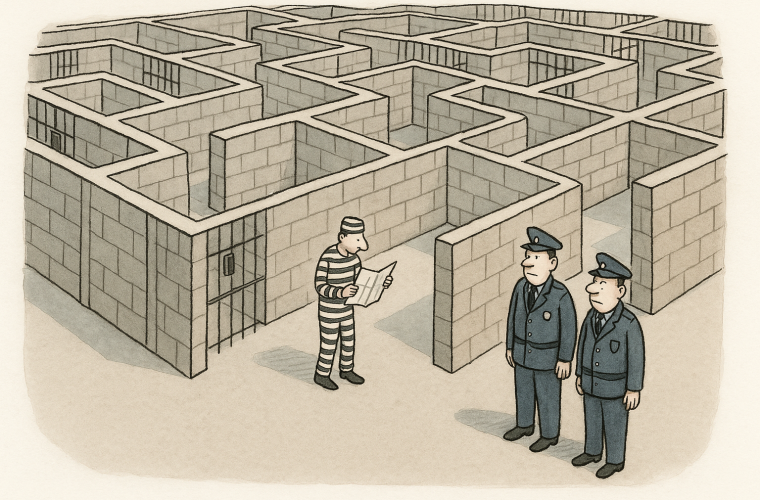
The first thing prison is supposed to take from you is choice. What you wear, when you eat, when the lights go out, which strangers you share a landing with — all surrendered at the gate along with your belt and your shoelaces. That’s the deal. That’s rather the point.
Which is what makes the reports about the prisoner Digwa so quietly extraordinary. According to the reporting that prompted this piece — and it should be said plainly that this rests on a single account — Digwa has been dictating which wing he will deign to occupy. Not requesting. Not petitioning through the proper channels with a biro and a complaint form. Dictating. And, apparently, being listened to.
How does a man whose crimes have made him a marked target — a man half the prison population would happily do serious additional time for the privilege of getting at — end up with more say over his accommodation than a tourist at a Premier Inn? The answer is less about him than about the institution around him, and it’s worth taking apart slowly, because once you see the machinery, the absurdity starts to look almost inevitable.
Start with the law. Prisons in England and Wales owe every inmate a duty of care, and since the Human Rights Act that duty has teeth: Article 2, the right to life, binds the state to take reasonable steps to protect prisoners it knows to be at risk. A death in custody triggers an investigation by the Prisons and Probation Ombudsman and an inquest, often with a jury, always with headlines. Rule 45 of the Prison Rules lets governors segregate a prisoner for his own protection, and vulnerable-prisoner wings exist precisely because some inmates cannot safely be left in general population.
All perfectly sensible. Nobody serious argues that the state should shrug and let the wing sort things out with a kettle of boiling sugar-water. We have been down that road before: Ian Huntley, one of the most reviled men in the country, was attacked in custody more than once, including having his throat slashed at HMP Frankland in 2010 — an incident widely reported at the time, and one that generated exactly the sort of scrutiny governors lie awake dreading.
And there’s the rub. The duty of care is universal in theory, but the consequences of failing in it are not evenly distributed. If an anonymous burglar gets a hiding on B Wing, it’s a paragraph in an inspection report. If the most notorious man in the building dies on a governor’s watch, it’s the front page, the urgent question in the Commons, the inquiry, the career. The system’s fear is not really of the violence. It’s of the headline the violence would generate.
Follow that incentive to its logical end and you arrive somewhere genuinely perverse: the more monstrous the crime, the more valuable the prisoner’s continued breathing becomes to the people holding him — and the more leverage he acquires. The shoplifter gets bunked wherever there’s a mattress. The man with a target on his back gets, in effect, a concierge service, because every request he makes can be dressed up — by him, and conveniently for everyone — as a security consideration. “I won’t be safe on that wing” is a threat and a plea at the same time, and the governor has no reliable way of telling which. Call his bluff and be wrong, and you’re the name in the ombudsman’s report.
It’s the prison-management equivalent of being too big to fail. HMP Wakefield didn’t earn the nickname “Monster Mansion” because it houses pickpockets; it houses the men whose deaths would be national news, and everything about their management reflects that. The institution isn’t soft. It’s scared — and scared institutions negotiate.
One should be fair to the Prison Service here, because the alternative readings are all worse. A service that let notorious inmates be quietly murdered would be a barbarism dressed as justice, whatever the phone-in callers say. Accommodating a prisoner’s stated fears is often the cheap option too: segregation units are expensive, staff escorts are expensive, and a wing move costs nothing but a little face. Six of one, half a dozen of the other, a governor might say, signing the paperwork and hoping nobody writes it up.
But somebody has written it up, and the picture it paints — if the account holds — is of an inversion nobody designed and nobody would defend out loud. Choice, the thing prison exists to remove, has been handed back to precisely the man from whom the public most wanted it taken, not as mercy but as risk management.
Because the uncomfortable truth is that nobody in this arrangement is protecting Digwa. They are protecting the institution from the morning his name appears above the word “dead” and below the word “failings”. He has simply worked out that he’s standing between the system and its worst headline — and that, in a prison, is the closest thing there is to holding the keys.