
Altitude sickness, the medical textbooks tell us, tends to kick in above 2,500 metres. English altitude sickness kicks in at the departure gate.
Mexico City sits at roughly 2,240 metres, and the Estadio Azteca — which will stage matches at the 2026 World Cup, its third go at hosting — squats up there with it, in air thin enough to make an unprepared midfielder feel like he’s running through wet sand while breathing through a straw. You can already hear the pre-match packages being cut. Graphics of oxygen molecules. A physiologist in a branded gilet explaining haemoglobin to a presenter nodding like a dashboard dog. And hovering over all of it, the great unspoken promise: if this goes wrong, it wasn’t our fault. It was the sky’s.
Only this time the alibi comes pre-stamped, because the tournament has done England’s excuse-making for them. The squad’s base camp is Kansas City, which sits at a bracing 270-odd metres — about as much altitude as a multi-storey car park in Halifax. You cannot teach your haemoglobin about thin air from the prairie. Whatever acclimatisation England manage before the Azteca will have been achieved in a hotel gym with the air conditioning set to ‘pleasant’.
Worse, the one workaround the boffins actually rate — the smash-and-grab, where you fly in on match day, play before your body has worked out where it is, and scarper before the altitude can introduce itself properly — is off the table. Teams aren’t allowed to fly in and out on the same day. So England must land the day before and marinate overnight in the thin stuff: long enough for the altitude to clock them, nowhere near long enough to adjust. The worst of both worlds, formally timetabled.
And adjustment, the science is clear, takes weeks. It has been clear since the 1968 Mexico City Olympics dragged the subject into the mainstream, nearly sixty years ago. Trekkers bound for Everest Base Camp spend the best part of a fortnight shuffling between teahouses so their blood can catch up — and that’s just to stand at the bottom of a mountain and take a photograph of it. The Sherpas strolling past with somebody else’s luggage have had generations to adapt. England will have a buffet breakfast, a team meeting and a lie-down.
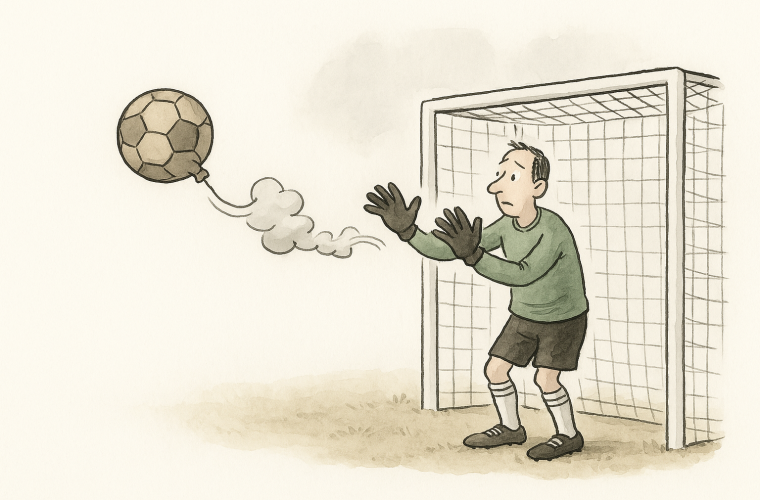
Then there’s the ball. Thin air means less drag, and less drag means the ball flies faster, carries further and swerves less than anyone’s instincts expect. Free kicks that would arc politely over a wall at sea level arrive like something off a driving range. Crosses sail. Long-range efforts dip late or not at all, and goalkeepers spend the evening misjudging flight like a man trying to catch confetti. Whisper it, but this is the one strand of the coming sob story with actual physics behind it — which is precisely why it’ll be mentioned least before kick-off and loudest afterwards.
The excuse has form, mind. To be fair to the ghost of Sir Alf Ramsey — a man who took preparation so seriously he shipped England’s own food to Mexico in 1970 — England have occasionally done the homework. Ramsey’s squad went out well ahead, warmed up with a South American tour, and promptly delivered the Bogotá bracelet farce: Bobby Moore detained over a jeweller’s accusation he was never convicted of. Acclimatisation achieved; dignity mislaid en route. England then went out to West Germany in León anyway, in a quarter-final remembered less for thin air than for the heat, and for Peter Bonetti deputising for a Gordon Banks laid low by a dodgy stomach. Preparation done, exit regardless, physiological villain still required. If it isn’t the altitude, it’s the sun. If it isn’t the sun, it’s the prawns.
Sixteen years later, at the Azteca itself, England went out at altitude again — and nobody blamed the oxygen, because a small Argentine had helpfully provided a hand. Which rather gives the game away. The excuse is a floating asset. It attaches itself to whichever fixture needs one.
And when England do prepare properly, the excuse simply migrates. In 2010, Fabio Capello based the squad at altitude in Rustenburg precisely so the South African highveld wouldn’t be a shock. England were then taken apart 4-1 by Germany in Bloemfontein — a defeat softened by Frank Lampard’s goal that wasn’t given, and by a national sulk about the Jabulani, a ball apparently designed by sadists to swerve only when Englishmen kicked it. The air was fine that summer, so the ball got it in the neck instead. Next year the two grievances finally merge — thin air and a misbehaving ball, each one vouching for the other. The pundits won’t know which to reach for first.
Because the alternative explanation is unbearable: the opposition was better, or the preparation was worse, or both. Blaming the altitude is respectable. It sounds scientific. It lets everyone — manager, federation, pundit, punter — walk away from the wreckage murmuring about red blood cells rather than asking who agreed to any of this. It is failure with a doctor’s note, countersigned in advance by the fixture computer.
So when the cameras pan across the Azteca next summer and a commentator solemnly intones the elevation figure like a eulogy, remember what you’re watching: an alibi arranged before the crime. Base camp on the prairie, one night in the thin stuff, a ball behaving like it’s been greased. England won’t even need to reach for the excuse. It’ll be waiting for them in the dugout — fully acclimatised, as ever, and match-fit.