
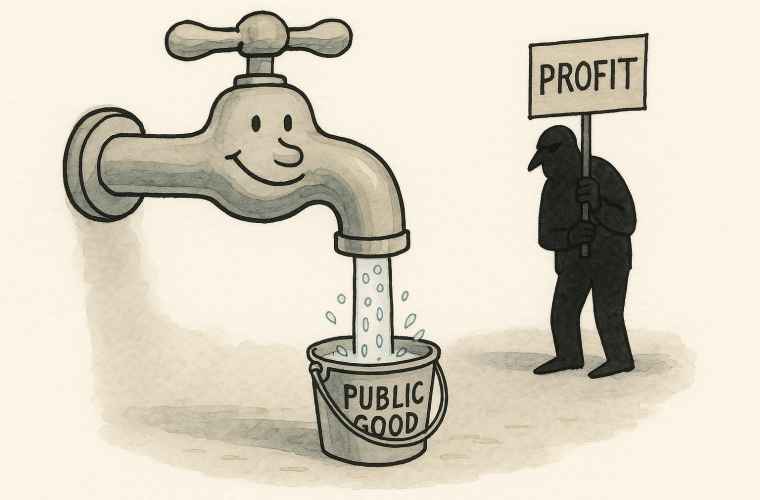
“Not for profit.” Say it a few times and it starts to sound like a moral position rather than a corporate structure. For the water industry, though, it’s less a philosophy than a bit of financial plumbing — and there’s a working example of it that the renationalisation cheerleaders never seem to want to talk about. It sits in Wales. It’s been there for nearly a quarter of a century. And the awkward thing is, it doesn’t obviously prove either side right.
Cast your mind back to 2001. Welsh Water — Dŵr Cymru, if you want to be proper about it — was bought by a not-for-profit company called Glas Cymru. The deal took the utility out of the hands of shareholders and put it into a structure with no equity owners at all. Any surplus, in theory, goes back into the business or to customers rather than out to City investors. On paper it’s the very thing that half the country now says it wants: water run for the public good, not for someone’s dividend.
So why doesn’t it feature on the placards?
Because the record is, in the technical parlance, a bit of a mixed bag. And a mixed bag is no use to anyone trying to win an argument.
The case for the defence
Start with the good bits, because there are some. Without shareholders demanding their cut, Glas Cymru could, at least in principle, plough money back into pipes and treatment works rather than out to institutional investors in the Home Counties. The not-for-profit model was pitched precisely as a way of lowering the cost of capital — no equity returns to service, just debt — and using the savings for the benefit of customers. That’s the sales pitch, and it’s a coherent one.
For years it was held up as the sensible middle way: neither the full-fat state ownership of the pre-Thatcher era nor the shareholder capitalism that everyone now loves to hate. A company limited by guarantee, run for its customers, quietly getting on with the unglamorous business of moving water about. If you wanted proof that there was life beyond the shareholder model, here it was, doing its thing without much fuss.
And that’s rather the point. It has been doing its thing without much fuss — which is more than can be said for some of its English cousins, who have managed to combine eye-watering debt piles with the sort of dividend behaviour that gets you hauled in front of a select committee.
The case for the prosecution
Here’s where it gets sticky. Welsh Water has not been immune to the great British obsession of the moment: sewage. Storm overflows, spills into rivers, the whole grim catalogue that has turned water companies into pantomime villains — Dŵr Cymru has had its share of the criticism, its own regulatory rows and its own moments of looking rather less than saintly. Being not-for-profit, it turns out, does not automatically make your outfalls behave.
Which rather punctures the fantasy, doesn’t it? The renationalisation romantics tend to talk as though the profit motive is the sole villain — strip out the shareholders and the rivers run clean, the bills fall, and the sun comes out. Wales is the inconvenient rejoinder. You can take the profit out of water and still end up with the same knotty problems of ageing infrastructure, climate-battered drainage systems and the eternal question of who pays to fix it all. The muck doesn’t read the ownership structure.
There is also the matter of what “public ownership” even means here. Glas Cymru isn’t the state. It isn’t a nationalised industry in the old sense — no minister sits atop it, no Treasury line covers its losses. It’s a private company with an unusual constitution. Call it public if you like, but it’s a good deal more complicated than a red flag over a reservoir.
The politics of not mentioning it
Enter, stage left, the mayors and the metro-devolutionists — Andy Burnham chief among them — banging the drum for taking things back into some form of public hands. Buses, in Manchester’s case, though the water debate rumbles along beside it. The rhetoric of a “devolution revolution” leans heavily on the idea that local, public-spirited ownership simply works better. It’s a warm and appealing story.
So you’d think Welsh Water would be Exhibit A. The one that got away from the privatised model, two decades before it was fashionable. Odd, then, how rarely it gets a namecheck. Perhaps because a case study that answers the question with a firm “well, sort of, up to a point” is precisely the kind of thing you leave out of a stump speech.
The truth, unsatisfying as ever, is that ownership structure is a lever, not a magic wand. Welsh Water suggests you can indeed run a utility without shareholders skimming the cream. It also suggests you’ll still be swearing at the same broken pipes and dodgy overflows the morning after the revolution.
Mid-table, then. Never relegated, never champions. Which is roughly where most grand schemes end up once the bunting comes down — and precisely why nobody wants it on the poster.