
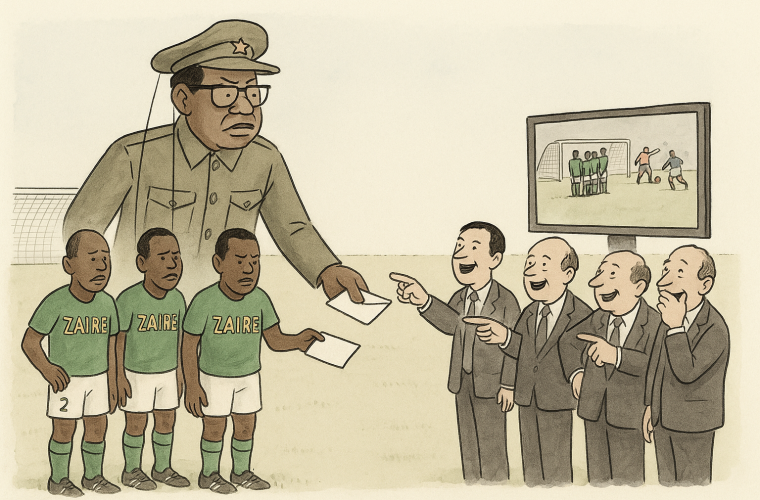
The World Cup of 1974 gave us Cruyff, the total football of the Dutch, and the West German machine that ground its way to the trophy. It also gave us a defender booting a free kick into row Z before the whistle had properly stopped echoing, and a stadium of foreign correspondents deciding, then and there, that the man hadn’t the foggiest how football worked.
That clip has outlived almost everything else from the tournament. You’ve seen it. Zaire versus Brazil, the dying minutes, the Brazilians lining up a free kick, and out charges Mwepu Ilunga to lash the ball away like a man clearing his garden of next door’s tennis balls. Cue the laughter. Cue forty years of it being shown on clip shows under captions like African team doesn’t understand the rules. Cue the smug little chuckle of the European viewer, comfortable in the knowledge that he, at least, knew where to stand at a wall.
What a load of patronising rot it turned out to be.
The official story, and why it’s pants
The official story is the one that flatters us. It casts the African as the naif, the lovable bumbler, the bloke who wandered onto the world stage without the manual. And let’s not dress it up as anything gentler than it is: the clip became a visual shorthand for the oldest, ugliest lie in the book — that Africans are simple souls who can’t quite grasp what the clever white men have mastered. Dumb Africans, ran the subtext, every time the footage rolled. It’s a comfortable tale because it requires nothing of the person telling it except a sense of superiority, which, where matters of race are concerned, has never exactly been in short supply round these parts.
But Ilunga has explained, more than once and to anyone who bothered to ask, what he was actually doing. He wasn’t confused. He knew full well you don’t charge a free kick. He did it deliberately — to waste time, to disrupt, and, by his own account, as a small act of protest. The man understood the rules perfectly. He understood something else far better than the giggling press box did: that he and his teammates had been comprehensively stitched up.
And there’s the rub. The joke was never on him. It was on us, and we’ve been telling it on ourselves for half a century — only the punchline was a slur, and we never even noticed we were the ones delivering it.
What the camera didn’t bother to show
To grasp the dash you have to understand what was happening to the Zaire squad off the pitch, which is to say behind a curtain the broadcasters never thought worth pulling back. The team had travelled to West Germany under the patronage of Mobutu Sese Seko, the kleptocrat-in-chief of what was then Zaire, a man who treated the national side as a propaganda prop and his nation’s treasury as a personal current account.
The players had been promised money. Bonuses, the lot. By the time they faced Brazil, the promised payments had reportedly failed to materialise, and the squad had worked out they’d been taken for mugs. Imagine — no, scratch that — consider being thousands of miles from home, representing a regime that’s quietly pocketed your wages, playing for national pride that you increasingly suspect is a one-way street. Yugoslavia had already put nine past them. The whole adventure was curdling.
So when Ilunga belted that ball away, he wasn’t a man baffled by the laws of the game. He was a man who’d run out of other ways to say enough. A small, futile, magnificent two fingers up at the entire pantomime. The referee booked him. Of course he did. The referee, like everyone watching, assumed he’d never read the rulebook — because that’s what you assume about a black African in a national shirt, isn’t it?
The cruelty of the easy laugh
There’s a particular nastiness in the way the clip has been used over the years, and it isn’t merely lazy — it’s racist, plain and unvarnished. It became shorthand for the African who didn’t get it, a handy little stereotype dressed up as a bit of harmless fun, trotted out whenever a lazy producer needed thirty seconds of footage to make a teatime audience feel clever at a black man’s expense.
And the real story — a player making a stand against a despot who’d nicked his money — was simply too inconvenient, too uncomfortable, too much like hard work to bother with. Far easier to keep the gormless-foreigner caption and move on. We chose the version that asked nothing of us, because the version that flattered us happened to be the one steeped in contempt for an entire continent.
It’s worth sitting with that for a moment, because it tells you everything about how the game, and the people who narrate it, have always treated the parts of the world that don’t speak in the right accent or carry the right passport. Skill from Brazil is artistry. The same instinct from Zaire is comedy. A white man’s mistake is a moment of misfortune. A black man’s deliberate act is proof he never understood the game at all. The bias isn’t always in what’s said. Sometimes it’s in what nobody can be bothered to find out, and sometimes it’s in the gleeful certainty that the chap with the darker skin must be the daft one.
The man, not the meme
Ilunga lived out his later years in his homeland, by various accounts in difficult circumstances, his fleeting global fame having earned him precisely nothing. He died in 2015. For a man whose three seconds of film are among the most-watched in football history — three seconds used to demean not just him but everyone who looked like him — that’s a galling arithmetic.
The lesson here isn’t really about football. It’s about the speed with which we reach for the flattering explanation, the one that confirms we’re the clever ones and somebody else is the prat — and how often, when the prat in question is African, nobody pauses to check the working. Ilunga knew the rules. He knew the score. He knew exactly what was being done to him and his teammates, and he found the only protest available to a man with no power and a ball at his feet.
We laughed at the one bloke on the pitch who saw the whole rotten setup clearly, and we laughed because he was black and we’d decided in advance that black meant clueless. Turns out the mug was wearing the blazer in the commentary box.