
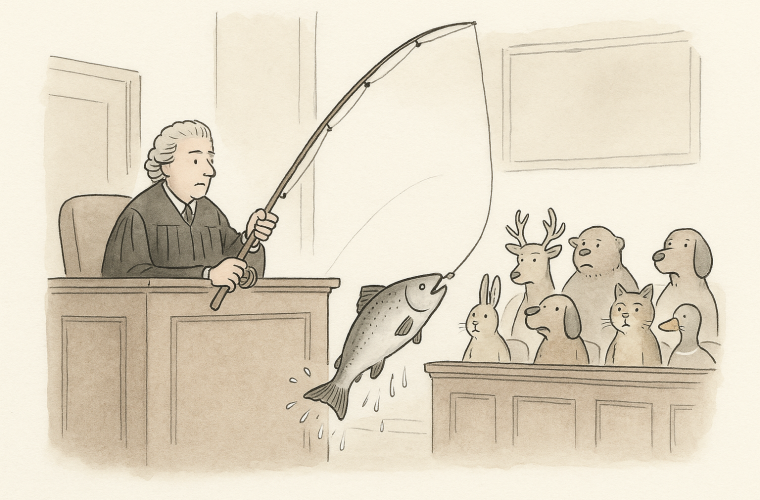
It is, at the time of writing, a criminal offence in England and Wales to handle a salmon in suspicious circumstances. Not to steal one, mind — theft was already covered, thank you very much, since roughly the Bronze Age. Section 32 of the Salmon Act 1986 exists because Parliament, faced with a poaching problem, decided the answer was a brand-new offence with a name that sounds like a rejected Monty Python sketch. Nearly forty years on, it’s still there. Nobody has ever mustered the energy to tidy it up.
And that, in one fishy anecdote, is the modern political disease. Ask a politician what they’ll do about anything — knife crime, potholes, the moral collapse of the young — and the answer is always the same: new legislation. A bill. A crackdown. Something with a stern name to wave at the cameras. Whether the last seventeen laws on the same subject were ever enforced, funded or even read is a question for the birds. Legislation has become the political equivalent of looking busy when the boss walks past.
The sausage machine never sleeps
The numbers are genuinely startling. New Labour, according to widely reported analysis at the time, created more than 3,000 new criminal offences between 1997 and 2010 — pushing towards one for every single day Tony Blair and Gordon Brown were in office. Not new laws, mind: new ways of being a criminal. One a day, like a vitamin.
The Cameron years were supposed to be the corrective. The coalition came in promising a bonfire of red tape — ‘one in, one out’ for regulation, later upgraded, with a straight face, to ‘one in, two out’. And yet by one count the Cameron administration still managed to produce over 4,000 new laws. That’s the thing about the sausage machine: even the people elected to switch it off end up feeding it. And that headline figure doesn’t even capture the real torrent, because most law in this country never troubles the House of Commons at all. It arrives as statutory instruments — ministerial regulations nodded through in their hundreds every year, scrutinised by approximately nobody, printed on legislation.gov.uk and read by even fewer.
Here’s the uncomfortable arithmetic: if a law worked, you wouldn’t need seventeen sequels. The fact that every Parliament produces a fresh Criminal Justice Act — there have been so many they need years bolted on to tell them apart, like Rocky films — is not evidence of vigour. It’s evidence that the last one didn’t do the job, and neither will this one, because the problem was never a shortage of statute. It was a shortage of coppers, courts, prison places and patience.
Everyone’s at it — except when they’re not
Is this a British affliction? Not entirely, though we do it with unusual enthusiasm. Look across the pond and you find the opposite extreme. Harry Truman famously campaigned against the ‘do-nothing’ 80th Congress of 1947–48 — which, for the record, passed roughly 900 bills. By that standard, recent Congresses are practically comatose: the 118th Congress managed only a few dozen laws in its first year, widely reported as one of the least productive in modern American history. Washington has discovered you can achieve legislative restraint through the simple mechanism of everyone hating each other too much to agree on lunch.
And then there’s Belgium — patron saint of the argument that maybe, just maybe, the whole circus is optional. Between 2010 and 2011 Belgium went 541 days without an elected government, a world record for a democracy. No ministers strutting about announcing crackdowns. No flagship bills. And the country did not collapse into the North Sea; by most accounts the economy kept growing while the politicians squabbled. Civil servants kept the lights on, the bins got emptied, and the citizenry discovered that an enormous amount of what government ‘does’ is theatre performed for its own benefit.
At the other end of the scale sits Italy, where the statute book is so bloated that nobody can agree how many laws the country actually has — estimates over the years have run into the tens and even hundreds of thousands, and successive governments have launched grand pruning exercises just to find out what’s in there. A legal system so overgrown you need an expedition to map it. Somewhere between Brussels-on-autopilot and Rome’s legislative jungle lies sanity, and no capital city seems terribly interested in finding it.
The hall of shame
The ridiculous stuff writes itself. The Licensing Act 1872 made it an offence to be drunk in charge of a horse, a cow or a steam engine — a law of its time, fair enough, except it’s still knocking about, waiting for some unlucky sod on a lively mare. The Easter Act 1928 fixed the date of Easter by statute; Parliament passed it and then never brought it into force, so it has sat on the books for nearly a century, a law in permanent limbo, like a bloke who bought the gym membership and never went. And in 2004 the government produced the Polish Potatoes (Notification) (England) Order, requiring anyone importing potatoes from Poland to notify the authorities in writing. Somewhere in Whitehall, a civil servant typed those words and hit save without a flicker of self-awareness.
But the truly instructive cock-up is the Dangerous Dogs Act 1991 — rushed through Parliament in a matter of weeks after a summer of horrific, headline-grabbing attacks. It banned dogs by breed rather than behaviour, which is a bit like banning cars by colour, and it has been the standing textbook example of knee-jerk lawmaking ever since. Every legal commentator in the land can recite it. ‘Dangerous Dogs Act’ is now shorthand among lawyers for what happens when the front pages write the legislation. And has that shame slowed anyone down? Has it heck. The tabloid-to-statute pipeline runs faster than ever.
Credit where it’s grudgingly due
Now, honesty compels the counter-argument, because the case against law-mania is not a case against law. Some Acts of Parliament have earned their keep magnificently. The Clean Air Act 1956 came after the Great Smog of 1952 killed thousands of Londoners — estimates ran from 4,000 at the time to far higher on later analysis — and it changed what the country breathed. The 1983 requirement to wear seatbelts was howled down as nanny-statism and went on to save lives by the thousand. The 2007 smoking ban in English pubs was going to kill the pub trade, we were told; the pubs that died were killed by rents and supermarkets, and everyone else got to come home from a session without smelling like a chimney fire. The National Minimum Wage Act 1998 was going to destroy jobs — a prediction that curled up and quietly died, unmourned, sometime around 1999.
Spot the pattern. Every one of those laws answered a proven, concrete, measurable problem. Each did one thing. Each was enforced. None was drafted in a fortnight to appease a headline. Good law is entirely possible — it’s just slow, boring and generates no photo opportunities, which is why it’s rationed like wartime butter while the flashy rubbish flows freely.
Fewer, better, and get the shears out
So do we need more laws? Occasionally, yes — when something new and genuinely broken turns up. What we need far more urgently is a government that treats the statute book like a garden rather than a landfill. The unglamorous heroes here are the Law Commission’s Statute Law (Repeals) Acts, which periodically go through the undergrowth binning dead legislation — the 2013 edition alone repealed more than 800 obsolete Acts in one glorious cull. Nobody held a press conference. Nobody got promoted. It was merely useful, and usefulness has no constituency.
Here’s a modest proposal for the next lot, whoever they are. Judge a Parliament not by the laws it passes but by the laws it repeals, consolidates and actually enforces. Require every shiny new offence to name the existing one it replaces. And before any minister is allowed near a ‘landmark bill’, make them explain, in writing, why the last landmark bill on the same subject is now landfill.
They won’t, of course. Announcing a new law costs nothing and photographs beautifully; making an old one work costs money and photographs like a spreadsheet. So the machine will grind on, the statute book will swell, and somewhere in England a man will glance nervously at a salmon and wonder whether he’s handling it suspiciously enough to be nicked. The law, as ever, will be watching. Whether it’s doing anything useful is another matter entirely.