
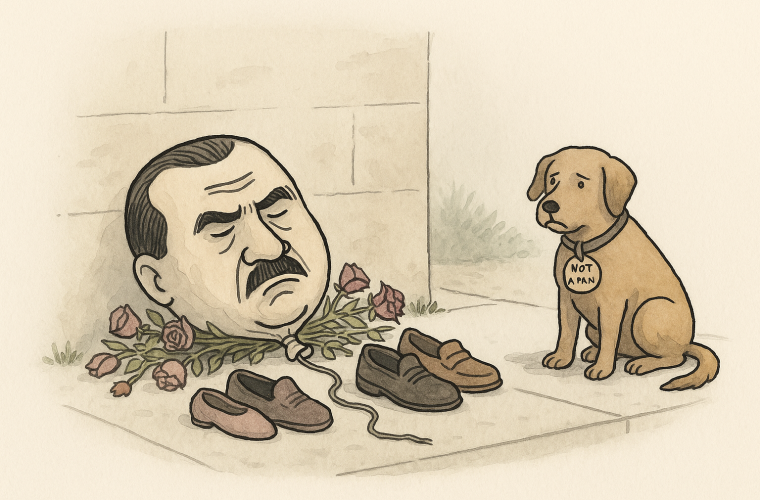
Shortly before dawn on 20 July 2011, a small crew of workmen in the Bavarian town of Wunsiedel dug up Rudolf Hess. Hitler’s deputy had been in the ground since 1987, when he hanged himself in Spandau prison at the age of 93, and the local Lutheran parish had finally had enough of him. The grave lease was up. With the family’s grudging consent, the remains were exhumed, cremated, and the ashes scattered at sea. The gravestone — engraved with Ich hab’s gewagt, “I dared” — was destroyed.
Why go to all that bother for a dead man? Because the dead man wouldn’t stay quiet. Every August, on the anniversary of his death, Wunsiedel was treated to a parade of shaven-headed pilgrims from across Europe, marching to the churchyard to honour the “martyr of peace” — a title that takes some brass neck when applied to a man who co-signed the Nuremberg race laws. The town of ten thousand souls had become a Nazi Lourdes, and the only cure the parish could find was to make the shrine disappear entirely.
It didn’t wholly work, of course. The marchers kept coming even after the grave had gone, saluting an empty patch of consecrated ground, which tells you most of what you need to know about the intellectual rigour on display. So in 2014 the residents tried something better than outrage: they turned the march into an involuntary charity walkathon, pledging ten euros to an anti-extremist organisation for every metre the neo-Nazis walked. The pilgrims raised thousands of euros for the fight against themselves. It remains the only recorded instance of that particular movement doing anything useful.
The Genghis Khan solution
The Wunsiedel parish was late to a very old problem: what do you do with the body of a monster, when there are always a few mugs about who fancy worshipping it?
The Mongols solved it eight centuries ago with characteristic thoroughness. When Genghis Khan died in 1227, legend holds that the burial party was killed to keep the location secret, the soldiers who killed them were killed in turn, and — depending on which chronicle you fancy — a river was diverted over the grave or a thousand horses trampled the earth flat. Nobody has found him since. Expeditions with satellites and ground-penetrating radar have gone looking around the sacred mountain of Burkhan Khaldun, where tradition places him, and Mongolia has politely made large tracts of it off-limits. Modern Mongolians mostly take the view that if the old man wanted to be found, he’d have left a forwarding address.
It is, whatever else you say about it, a clean solution. No grave, no pilgrims. No shrine, no annual embarrassment. The twentieth century’s tyrants, being vainer and better documented, left far messier estates.
Flowers for Uncle Joe, tyres for Brother Number One
Stalin got the full pharaoh treatment when he died in 1953 — embalmed and laid out next to Lenin in the mausoleum on Red Square, two waxworks for the price of one queue. It lasted eight years. In 1961, with de-Stalinisation in full swing, the party quietly hauled him out one night and buried him by the Kremlin wall under several layers of concrete, which is about as pointed a demotion as Soviet protocol allowed. And yet, every anniversary, the faithful still turn up with red carnations for the man who starved and shot their grandparents’ generation by the million. The queue is smaller than it was. It is never, dispiritingly, zero.
Pol Pot managed the least ceremonious exit of the lot. When he died in 1998, still under house arrest by his own former comrades in the Cambodian border town of Anlong Veng, his body was cremated on a pile of rubbish and old car tyres. No marble, no eternal flame — a bonfire of junk for a man whose regime killed perhaps a quarter of his own country. The site later acquired a tin roof and a modest sign, and reports over the years have described locals visiting to ask the late Brother Number One for winning lottery numbers. There’s a doctoral thesis in that somewhere, about what the human need for luck will forgive, but the short version is: even a genocidal maniac cremated on tyres can’t be relied upon to stay unvisited.
Spain, for its part, only got round to evicting Franco from his basilica in the Valley of the Fallen in 2019, forty-four years after his death, once the annual fascist nostalgia sessions at his tomb had become too embarrassing to ignore. The pattern holds everywhere: leave a monster a fixed address and someone will turn up with flowers and a stiff right arm.
The pound-shop Führer
Which brings us to the pilgrims themselves, because they’re the actual story. The dead men are just furniture.
Who stands outside a Bavarian churchyard in August saluting a man who’s been dead since 1987? Speaking as fair comment rather than clinical diagnosis: it’s rarely anybody with much else going on. The recruiting ground for this stuff has always been the bloke nobody listens to — the one convinced he’s destined for greatness and that the world’s failure to notice is a conspiracy rather than a verdict. The dead dictator offers him a ready-made fantasy: once upon a time, a nobody with a grievance and a bad haircut became the most feared man in Europe. Why not me?
It’s the martyrdom that does the heavy lifting. A living leader can disappoint you — can lose a war, sign a bad treaty, turn out to be human. A dead one is pure potential, endlessly flattering, permanently unfalsifiable. The graveside pilgrim isn’t really mourning; he’s auditioning. Every salute says I would have been one of the great ones. I’d have mattered.
Here’s the joke, though, and it’s a bleak one. These regimes they moon over would have chewed them up in a fortnight. The historical machinery they romanticise had no vacancies for sensitive lads who feel unappreciated; it ran on men capable of sustained, industrial ruthlessness, and it devoured its own hangers-on as a matter of routine — ask the SA leadership how the Night of the Long Knives went for the true believers. The average graveside saluter wouldn’t have made the grade for a tenth of the brutality he fantasises about administering. He’d have been the informed-upon, not the informer; the purged, not the purger. He’s cosplaying as the boot while possessing all the qualifications of the face.
That’s what makes the pilgrimage so pathetic rather than merely sinister. It’s not a movement. It’s a support group for men who’ve confused being ignored with being oppressed, gathered around a hole in the ground that, in Wunsiedel’s case, doesn’t even have anyone in it any more.
Report to the front desk
And so to Braunau am Inn, the pretty Austrian border town where, in a yellow three-storey house at Salzburger Vorstadt 15, Adolf Hitler was born in April 1889. The family cleared off when he was an infant, and by rights the building should be a footnote. Instead it spent decades as Austria’s most awkward piece of real estate, drawing its own trickle of 20 April visitors, while outside it a granite memorial stone — quarried at Mauthausen concentration camp — reminded passers-by: never again fascism, millions of dead admonish us.
For years the state rented the house, mothballed and argued about it. Tear it down and you create a vacant lot for pilgrims to be photographed in. Make it a museum and you’ve built the shrine yourself. In 2016 Austria simply expropriated it from its private owner, and after much deliberation announced the most quietly brilliant solution in the whole sorry genre: the birthplace of Adolf Hitler is being converted into a police station.
Sit with that for a moment. The Mongols diverted a river. The Lutherans dug up the coffin. The Austrians are installing a duty sergeant.
Because consider the practicalities from the pilgrim’s side. You’ve saved up, driven to the Innviertel, rehearsed your look of noble Aryan sorrow — and the sacred site is now a functioning cop shop. Performing an illegal Nazi salute (and it is illegal in Austria, under laws written specifically for the likes of you) outside a building full of police officers is not martyrdom. It’s a home delivery. You’ve arranged your own arrest with the efficiency your heroes only ever claimed to possess, and the walk from crime scene to custody suite is roughly one door.
There’s your monument to the thousand-year Reich, and to every sad act who dreams of restarting it: a front desk, a booking form, and an officer asking you to mind the wet floor. The disaffected pilgrim came looking for destiny. What history has left him is a caution and a court date — which, on the evidence, is precisely the grade he makes.