
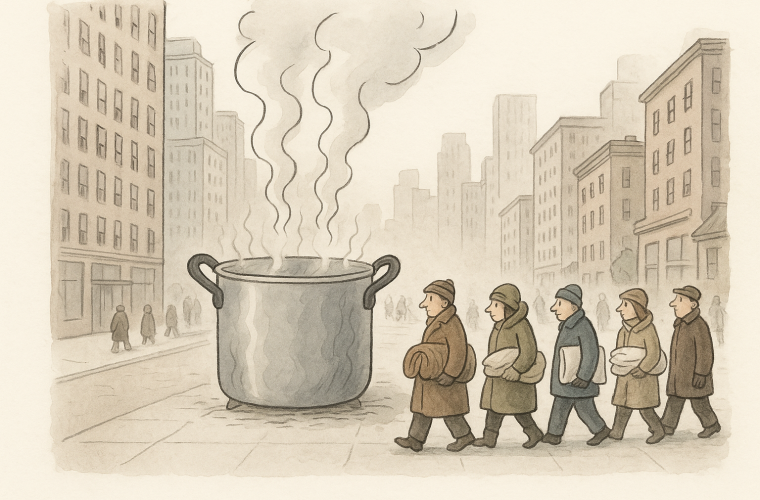
Two-thirds of the energy produced by a typical nuclear power station goes straight into the nearest large body of water. Not through incompetence, not through some scandalous cover-up, but through the plain arithmetic of thermodynamics: a reactor turns roughly a third of its heat into electricity, and the rest — an ocean of hot water — is politely poured away into a lake, a river or the sea, where it warms the fish and achieves nothing else whatsoever.
Which is a strange state of affairs when you consider that a few kilometres from some of these stations sit millions of people burning natural gas to keep their radiators lukewarm. We have, in effect, built machines that produce heat on a civilisational scale, and then built cities next to them that pay through the nose to produce more heat. It is the energy-policy equivalent of standing beside a roaring bonfire and popping to the shops for a hot water bottle.
The fix has a name — district heating — and a growing band of engineers, from Helsinki to Toronto, who think its moment has finally arrived.
The Finns got there first
District heating is not a new idea; it is an old idea that the Anglosphere mislaid. Instead of every building running its own boiler, a central plant heats water and pumps it through insulated pipes under the streets, into heat exchangers in basements, and out to radiators and taps. One big, efficient, well-run source instead of a million small, temperamental ones. In Helsinki, district heating serves around ninety per cent of the city’s buildings, and Copenhagen’s network reaches a similar share — figures reported consistently by the cities’ own utilities. When Nordic winters bite, nobody is bleeding a boiler in the dark.
The genuinely clever bit is what you feed into the network. Because the pipes don’t care where the hot water comes from, a district heating system is fuel-agnostic: coal yesterday, biomass today, waste heat from data centres and — increasingly — nuclear reactors tomorrow. Helsinki’s utility Helen has been closing its coal plants and hoovering up warmth from wherever it can find it, including server halls. Finland’s national research centre VTT has gone a step further and designed a small modular reactor, the LDR-50, whose entire job is district heating — no turbines, no grid, just a reactor built to warm a city, running at temperatures closer to a kettle than a power station.
And the concept is no longer theoretical. In Shandong province, China’s Haiyang nuclear plant began piping waste heat into the local network in 2019 and has since, according to its operator, extended coverage across the whole city — retiring dozens of coal boilers in the process. Switzerland has been quietly at it for four decades: the Beznau plant has fed the Refuna district heating network, serving a string of villages along the Aare, since the mid-1980s. Nobody writes breathless headlines about it. It just works, which is rather the point.
Toronto already has the pipes
Here is where the story turns towards Canada, and where it gets genuinely cheering. Because Toronto is not starting from scratch — it is arguably further along than any city in North America, just facing the other way.
Since 2004, the company Enwave has run Deep Lake Water Cooling in downtown Toronto: three enormous intake pipes reaching tens of metres down into Lake Ontario, where the water sits at a constant, bracing four degrees or so year-round. That cold is drawn up and used to air-condition a large swathe of the downtown core — hospitals, banking towers, city buildings — in what Enwave describes as one of the largest lake-source cooling systems in the world. The same firm runs an extensive district steam-heating network beneath the city’s streets, some of it dating back over a century.
Read that again slowly. Toronto already has a utility with district energy pipes under its financial district, already has the legal and commercial framework for selling thermal energy by the pipe, and already has a public that thinks nothing of its office tower being cooled by a lake. The cultural leap that terrifies planners elsewhere — persuading people that heat can arrive like water or broadband — was made twenty years ago. The question is no longer whether Torontonians will accept networked thermal energy. They’re sitting in it.
And the pressure to extend the idea is real. The city’s own TransformTO climate strategy identifies natural gas burned in buildings as the largest single source of Toronto’s emissions, and commits the city to net zero by 2040. You do not get there by swapping boilers one condo at a time.
The reactors next door
Now look east along the lakeshore. Ontario is one of the most nuclear provinces on Earth: reactors at Pickering, Darlington and Bruce supply roughly half its electricity, according to the province’s system operator. Pickering sits about thirty kilometres from downtown Toronto; Darlington perhaps seventy. Every one of those stations is, right now, dutifully warming Lake Ontario with the heat it cannot turn into electricity.
The timing could scarcely be better. Ontario Power Generation is building the first of four small modular reactors — GE Hitachi’s BWRX-300 design — at Darlington, a project the province has trumpeted as the first grid-scale SMR in the G7, with construction approval granted in 2025. Pickering, meanwhile, is slated for refurbishment rather than retirement. In other words, Ontario is about to spend a generation rebuilding and expanding its nuclear fleet — which means a generation of design decisions in which heat offtake could be included from the drawing board, rather than bolted on afterwards at ruinous cost. Canadian Nuclear Laboratories at Chalk River has studied nuclear cogeneration and small reactors for heat applications; the intellectual groundwork, in Canada, is being laid by Canadians.
Europe offers the template. Finland’s Fortum has repeatedly studied piping heat from its Loviisa plant some eighty kilometres to Helsinki — an idea rejected on cost in 2009 but revisited as carbon prices climbed. What killed it a decade and a half ago was cheap fossil heat. That corpse is no longer breathing.
The honest bit
A battle-hardened optimist declares an interest in the difficulties, so here they are. Distance matters: hot water loses temperature and money with every kilometre of pipe, and thirty kilometres of insulated main under the Greater Toronto Area is a civil engineering project to make grown accountants weep. Retrofitting buildings designed for forced-air gas furnaces — the North American norm, unlike Europe’s radiator-friendly housing stock — is slow and unglamorous. Regulators will want assurance, reasonably enough, that a heat pipe from a nuclear station carries heat and nothing else (it does — the water in the city network never touches the reactor circuit, only a heat exchanger, as forty years at Beznau demonstrate). And there is the perception problem: ‘nuclear-heated radiators’ is a phrase that writes its own tabloid headline.
But consider the counter-argument properly, because it deserves it. Every one of these obstacles is an engineering or communications problem with known solutions, deployed at scale, in countries no richer or cleverer than Canada. None is a law of physics. The law of physics, inconveniently for the sceptics, is on the other side: the heat exists, it is being thrown away, and the alternative is burning imported gas inside city limits forever.
A city that heats itself
And this is where the climatically changing world comes in. District heating’s quiet superpower is resilience. A networked thermal system can switch fuels as prices and politics lurch; it can bank heat in storage tanks against cold snaps; it can serve the vulnerable without asking each household to find five figures for a heat pump. In a century that will serve up nastier winters, hotter summers and jumpier energy markets, a city with shared thermal infrastructure is a city with options. Toronto’s deep lake system already proves the summer half of the equation. The winter half is sitting offshore at Pickering, steaming gently.
There is something rather lovely, when you stand back, about the shape of the solution. Not a moonshot, not a gadget, not an app. Pipes. Insulated pipes, dug into streets by people in high-vis, connecting a heat source humanity already built to homes humanity already needs to warm. The Finns did it, the Swiss did it without fuss for forty years, the Chinese did it at speed, and the Danes made it a national character trait. Toronto — with its lake-cooled towers, its buried steam mains, its nuclear neighbours and its 2040 deadline — is better placed to do it than almost any city on the continent.
The heat is already there. It has been there all along, pouring uselessly into Lake Ontario while the city above shivers and pays for gas. All anyone has to do is catch it. That’s not a pipe dream. It’s a pipe.