
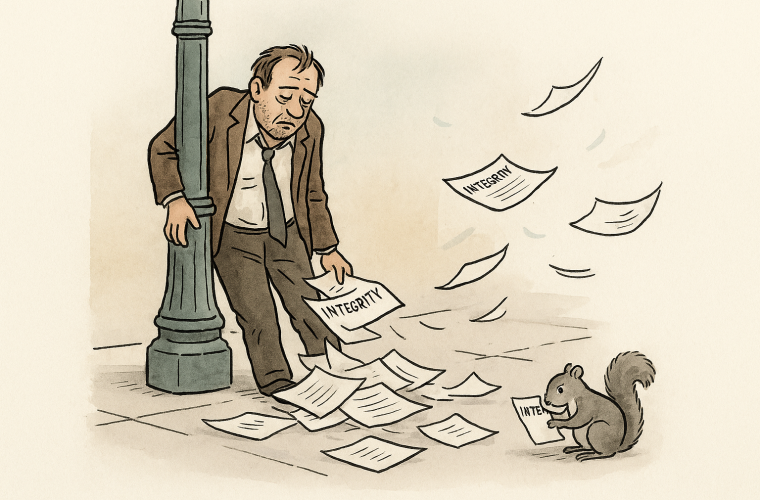
The world’s most widely used plagiarism detector cannot detect plagiarism. It never could. What Turnitin and its rivals actually do is match strings of characters — a task closer to spotting duplicate barcodes than to reading — and for twenty-odd years universities have treated the resulting percentage as if it were a moral verdict. It is not. It is a count of coincidences, some damning, most meaningless, and the entire apparatus of academic integrity has been leaning on it like a drunk on a lamppost: for support rather than illumination.
This matters right now because of what has been happening at Cambridge, where allegations of plagiarism concerning Professor Jason Arday’s 2015 doctoral thesis have been circulating — allegations which remain contested, which Arday has not been found by any published process to have committed, and which have, entirely predictably, curdled into a culture-war slanging match within about a fortnight of surfacing. One trench is convinced the case proves everything it already believed about diversity appointments; the opposite trench is equally convinced it proves everything it already believed about who gets scrutinised and why. Neither trench, as far as anyone can tell, has spent much time on the actual text.
Which is a shame, because buried under the noise is a genuinely important shift in how the question “did this text come from that text?” can be answered at all.
The row nobody is winning
Arday’s appointment at Cambridge in 2023 was widely celebrated, and the subsequent allegations about his 2015 thesis were always going to be radioactive. To be scrupulous about it: allegation is all they are. No adjudicated finding of misconduct against him has been published, and questions of what he did, knew or intended remain precisely that — questions, for due process rather than a comment section.
But a recent forensic analysis of the thesis, supplied to this desk, is interesting less for what it alleges about one academic than for how it goes about alleging it. Rather than running the document through a legacy checker and waving a percentage around, the analysis tested 11.09 million sentence pairs — every sentence in the thesis against every sentence in a set of candidate source texts — and compared the results against a control baseline of 34 million sentence pairs drawn from documents known to be independent of one another. The method is the story here. Because whatever eventually happens in the Arday case, this is what the machinery of textual forensics is going to look like from now on, and it is worth understanding before it gets pointed at anyone else. Which it will.
Why the old kit fails in both directions
The trouble with string-matching is that it fails in both directions at once, which is quite an achievement for a piece of software.
In one direction, it generates false positives by the bucketload. Academic fields have shared vocabularies, and the software cannot tell the difference between theft and terminology. Every sociology-of-education thesis written this century will invoke Bourdieu and cultural capital; every methods chapter contains near-identical boilerplate about semi-structured interviews and thematic analysis; every literature review cites the same canonical passages in the same conventional way. A string-matcher flags all of it, and a nervous administrator sees a 34% similarity score and reaches for the disciplinary handbook, when most of that 34% is simply what it sounds like when two people write about the same subject in the same discipline.
In the other direction, it misses the thing it exists to catch. Take a paragraph, swap a dozen words for synonyms, shuffle a few clauses, and the string-matcher goes blind — even though the argument, its ordering, its examples and its intellectual skeleton have been lifted wholesale. Structural paraphrasing, the form of borrowing that actually matters, sails straight through. The legacy checker is a metal detector on a beach: it shrieks at every ring pull and bottle top while the buried safe sits two feet down in silence.
So institutions have spent two decades punishing the clumsy and missing the careful, then wondering why nobody trusts the numbers.
Vectors, tails and the shape of borrowing
The newer approach starts from a different question. Not “do these words match?” but “do these sentences mean the same thing, and is the pattern of that sameness explicable by chance?”
The first tool is the sentence embedding. A model such as all-MiniLM-L6-v2 — small, open, unglamorous — converts each sentence into a vector: a point in a several-hundred-dimensional space, positioned according to meaning rather than spelling. Sentences that say the same thing land near each other even when they share barely a word. The distance between two such points, measured as cosine similarity, tells you how close two sentences are in meaning on a scale where 1.0 is identical and 0 is unrelated.
Here is the crucial, counterintuitive finding: the aggregate score is useless. Across same-field documents written entirely independently, the analysis found an average cosine similarity of 0.280 — a substantial background hum of resemblance that exists simply because two theses about the same subject will always sound somewhat alike. Anyone waving an average similarity figure as evidence of plagiarism is, on this maths, talking rubbish. The signal is not in the middle of the distribution. It is in the tail.
This is where the control baseline earns its keep. By testing 34 million sentence pairs from documents known to be independent, the analysis established what innocent overlap actually looks like: how often unrelated same-field texts produce sentence pairs at 0.7 similarity, at 0.8, at 0.9. Chance produces a predictable, rapidly thinning tail. When the thesis-versus-source comparison produces a tail that is fat where the control’s is thin — clusters of near-identical sentence pairs far beyond what independence predicts — you have something that needs explaining.
The second tool is older-fashioned but sharpened by statistics: lexical run analysis. Two independent authors will occasionally produce the same run of four or five consecutive words; set phrases and standard citations see to that. But the probability of matching runs falls off a cliff as the runs lengthen, and that fall-off can be modelled with a Poisson distribution — the workhorse mathematics of rare events, the same tool actuaries use to predict how many claims land on a quiet Tuesday. The model tells you how many long shared word-runs chance should produce between two independent texts of a given length. When the observed count dwarfs the expected count, the hypothesis of independence doesn’t merely weaken; it collapses. One matching lottery ticket is luck. Matching tickets week after week is a syndicate.
The analysis also examined what it calls self-referential chapter structures — the internal architecture of chapters, the order in which arguments are staged and sub-sections deployed. Structure is a fingerprint that survives even diligent rewording: you can change every noun and still leave the scaffolding standing exactly where you found it.
Put together, the pipeline’s output is not a similarity percentage but a probability statement about textual lineage: the claim that one text descends from another, quantified against a rigorous model of coincidence. The analysis contends that, in the case of the 2015 thesis, these tail-end statistics establish derivation. That contention has not, so far as we know, been independently replicated, and it should be read as an allegation with mathematics attached rather than a verdict.
The poacher turned gamekeeper
Now for the punchline, and it is a proper one. The entire forensic pipeline — the embedding runs, the Poisson modelling, the control baselines — was, per the analysis, written and executed via Claude Opus 5. A large language model. The same class of technology currently accused of industrialising academic dishonesty, of writing half the undergraduate essays in Britain, was here doing the detecting.
There is something almost music-hall about it: the burglar’s toolkit repurposed as the locksmith’s. But it makes complete technical sense. Large language models are built on the same embedding mathematics that powers the forensics; a system trained to understand paraphrase at scale is precisely the system you’d want hunting for it. And there is a distinction worth being careful about. AI tools that claim to detect AI-written text are notoriously flaky — that is a genuinely hard problem, littered with false accusations against innocent students. This is a different job entirely: detecting derivation between two human-written texts, with the model acting as statistician and code-writer rather than oracle. The model doesn’t peer at prose and declare it dodgy on vibes. It builds a probabilistic apparatus that a human — or another machine, or a sceptical reviewer — can audit, rerun and challenge.
That said, a pipeline written by a machine deserves at least as much scrutiny as one written by a postdoc at two in the morning, and arguably more. Code should be published, baselines inspected, results replicated. A single unreplicated analysis, however elegant, is evidence of a method’s promise, not of anyone’s guilt. The proper response to an impressive tail-end statistic is not a verdict but a request to see the workings.
What the maths cannot tell you
And here we arrive at the boundary that the culture warriors on both sides seem determined to blunder past. Suppose the mathematics is flawless. Suppose the tail-end statistics establish, beyond any reasonable statistical doubt, that one text descends from another. What, exactly, has been proven?
Textual lineage. Nothing more. The numbers cannot tell you whether the borrowing was deliberate theft or catastrophic note-taking — the researcher who pastes source material into a working document and, years later, can no longer distinguish their own words from another’s. They cannot tell you what the disciplinary conventions of 2015 were, or how they were understood by a particular doctoral candidate at a particular institution. They cannot tell you what the supervisors read, what the examiners checked, or why a thesis passed through a viva and an examination process without anyone raising a flag — questions of institutional oversight that are, if anything, more uncomfortable than questions of individual conduct, and correspondingly less discussed. And they certainly cannot tell you whether misconduct, in the formal sense that ends careers, occurred. That is a judgement about norms, disclosure and honesty, and it belongs to human processes: investigation, representation, the right to reply.
The risk, as this kind of forensic tooling spreads, is that institutions launder judgement through numbers — that “the algorithm established derivation” quietly becomes “the algorithm found him guilty,” skipping the human bit in the middle because the human bit is slow, expensive and awkward. That would be every inch as lazy as the old regime of waving Turnitin percentages about, just with better maths and more decimal places.
So where does that leave us? With better instruments and the same old problem, which is roughly where progress usually leaves us. The machines can now tell us, with genuinely startling precision, where the words came from. Whether anyone did anything wrong remains a stubbornly human question — and no amount of cosine similarity is going to answer it for us. Which, depending on which side of the examiners’ table you happen to be sitting, is either a comfort or a warning.