
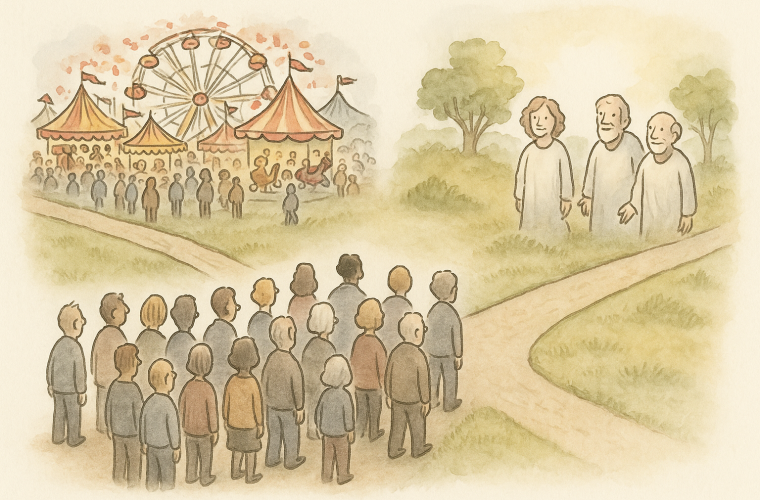
Death, these days, has a marketing department. There are bestselling memoirs of heaven, streaming documentaries about surviving it, TED talks with soft lighting, and a steady drip of neuroscience press releases about the dying brain lighting up like the Blackpool illuminations. Eben Alexander’s Proof of Heaven shifted copies by the million. The afterlife, whatever else it is, is a growth sector.
Spend any time with the actual research on what dying people report, though, and the product doesn’t quite match the packaging. The accounts coming out of hospices and trial programmes are quieter, stranger and considerably less cinematic than either the heaven-mongers or the debunkers would have you believe. Which is precisely why they’re worth reporting straight, before anyone gets to conscript them.
Start with the most substantial body of work we have: the research led by Dr Christopher Kerr at Hospice Buffalo in upstate New York. In a 2014 study published in the Journal of Palliative Medicine, Kerr’s team interviewed hospice patients about their dreams and visions in the weeks before death, and found the great majority reported at least one — vivid, distinct from ordinary dreaming, and, tellingly, becoming more frequent as death approached. The content? Not tunnels of light. Not cosmic judgement. Mostly the dead: mothers, fathers, spouses, old friends. The recurring themes Kerr’s team catalogued were reunion and preparation — meeting people long gone, or getting ready for a journey. His patients, by his account, rated visits from deceased relatives as the most comforting of the lot, and distressing visions were the minority.
That’s it. That’s the great dispatch from the threshold: your mum turns up, and it helps.
Now, one can read this two ways, and people reliably do. The believers take it as evidence of a welcoming committee. The materialists take it as a dying brain running its greatest hits — a sort of neurological clip show before the channel goes dark. Both camps treat the hospice patient as a witness for their side, which is a bit rich given that, in Kerr’s telling, the patients themselves rarely frame these experiences as metaphysical claims at all. They describe them the way you’d describe a visit. The theorising is added afterwards, by the living, who — it must be said — often have books out.
The neuroscience, meanwhile, is genuinely interesting and genuinely thin. In 2023, a University of Michigan team led by Dr Jimo Borjigin published findings that two of four comatose patients, after being removed from ventilator support, showed a surge of gamma-wave activity — the sort associated with conscious processing — in the dying brain. Fascinating. Also a sample of two, as the researchers themselves acknowledged, which is roughly the evidential weight of a pub anecdote in most other fields. Still, the frequency matters. Gamma waves are the brain’s fastest oscillations, humming along at around forty cycles a second, and they turn up when the brain is doing its most sophisticated work — binding sight, sound and memory into a single conscious moment. They are, as near as neuroscience gets to one, the signature of awareness. Finding them surging in a brain that should be closing down for good is, at minimum, a genuine puzzle.
It is also catnip for the quantum consciousness brigade — which brings us, inevitably, to Sir Roger Penrose and Stuart Hameroff. Penrose, a Nobel laureate in physics and nobody’s idea of a crank, and Hameroff, an American anaesthetist, have spent three decades arguing that consciousness isn’t computation at all but a quantum process playing out in microtubules — tiny protein scaffolds inside neurons — with each “orchestrated” collapse producing a discrete moment of experience. On their account, the gamma rhythm is roughly the beat of that process, which is why the theory’s admirers seize on end-of-life gamma surges with such enthusiasm. Hameroff has gone further, suggesting that when the body packs up, the quantum information involved needn’t simply vanish — it could, in principle, disperse into the universe at large, which is about as close as anyone with serious physics credentials gets to endorsing a soul. Most neuroscientists regard the whole edifice as elegant speculation, and they may well be right. But it’s fair to call it the respectable end of a market that mostly trades in far shoddier goods.
The same year as the Michigan findings, Dr Sam Parnia’s AWARE-II study reported that some cardiac arrest patients showed spikes of brain activity well into resuscitation, and that a minority of survivors described lucid experiences of the event. Careful work, honestly caveated by its authors — and promptly inflated by half the internet into proof of the soul and by the other half into proof there isn’t one.
Then there are the trial programmes proper. The 2016 psilocybin studies at Johns Hopkins and New York University found that a single guided dose produced substantial, lasting reductions in anxiety and depression among patients with life-threatening cancer. Participants in that body of research often described what the investigators call mystical-type experiences — a sense of unity, of something larger. Whether that’s a glimpse behind the curtain or a chemical holiday is not a question the data can answer, and the better researchers don’t pretend otherwise. What the trials can say is narrower and more useful: something in the experience made dying less terrifying. For a hospice patient, that’s not a footnote. That’s the whole point.
And tucked away in the literature is the oddest phenomenon of all: what the biologist Michael Nahm termed terminal lucidity — the unexpected return of clarity in patients with advanced dementia, sometimes hours before death. Under-studied, poorly understood, and stubbornly resistant to both camps’ tidy stories.
None of this is new, incidentally. The physicist William Barrett was collecting deathbed visions in a 1926 book of that name, back when the fashionable framing was spiritualism rather than quantum consciousness. Every generation dresses the same quiet reports in its own vocabulary — séance then, microtubules now — and every generation is convinced it’s finally cracked it. The reports themselves barely change. Mothers. Journeys. Reassurance.
So where does that leave us? Somewhere unfashionably in the middle, as usual. The evidence for another realm is not there; the evidence that dying people routinely experience something vivid, structured and consoling very much is. The honest position is to report what they say and resist the urge to make it mean what we’d like.
Because the dying, on the record we actually have, aren’t sending back dispatches from the other side. They’re finishing something on this one. The only truthful headline is the one nobody would click: at the end, people see the ones they loved — and it helps.