
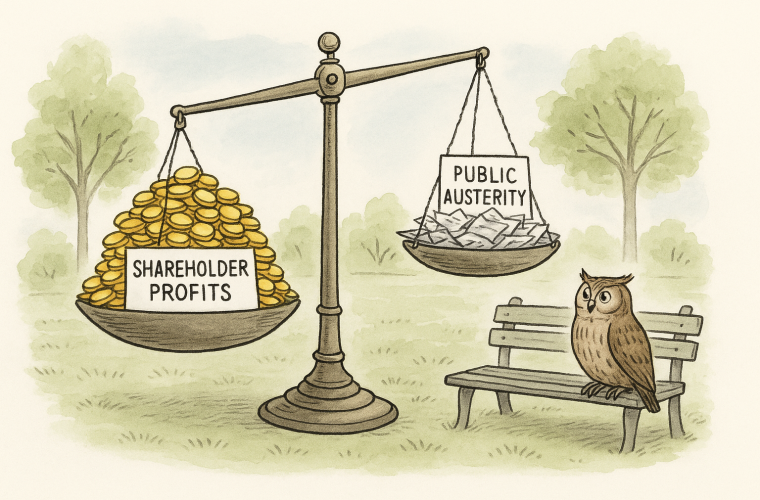
There is a particular kind of silence that descends on a room when a politician says the word “productive” with a capital P. You can almost hear the spreadsheets sweating. Somewhere in the Square Mile a man in a quarter-zip puts down his flat white and frowns, because he has read enough white papers to know that when the prose gets ambitious the costings get vague, and when the costings get vague, someone — usually him, eventually — ends up holding the bill.
The paper in question is The Productive State, the Greater Manchester think-piece bearing Andy Burnham’s fingerprints, and its central conceit is genuinely arresting: unwind four decades of privatisation not by writing fat compensation cheques to shareholders, but by swapping their equity for government bonds. You hand over your shares in the water company; the state hands you a gilt. No cash changes hands at the point of nationalisation. The taxpayer doesn’t cough up a king’s ransom on day one. The asset comes home. Everybody, in theory, keeps their dignity.
It is, you have to concede, a clever bit of financial origami. The trouble with traditional nationalisation has always been the price tag — buying back the family silver at the price the new owners have spent thirty years inflating. Bonds-for-shares sidesteps the upfront wallop. Instead of a lump sum, you issue paper and promise to pay it back over time, with interest. Tidy. Elegant. The sort of thing that sounds marvellous at a fringe event in a converted Mancunian mill.
And then someone in the back row, nursing a warm lager, asks the only question that matters: who pays the coupon?
The bond market doesn’t do romance
Here is the bit the brochure tends to gloss over. A government bond is not a magic spell that makes liabilities vanish; it is a debt. You have simply changed the shape of the obligation, not its existence. Where once you’d have a one-off acquisition cost, now you have a stream of interest payments stretching out over decades, and those payments land squarely on the public balance sheet. The shareholders haven’t been wished away. They’ve been turned into creditors. And creditors, unlike shareholders, get paid first.
The gilt market — that vast, humourless arbiter of what a government can actually afford — has a long memory and zero sentiment. It does not care whether your scheme is morally splendid or your intentions pure. It cares about supply, yield, and whether it believes you can service what you’ve issued. Flood it with a great wodge of new paper to buy out the water, energy and rail companies, and the market will want compensating for the risk in the only language it speaks: higher yields. Higher yields mean a higher cost of borrowing across the board. We have, fairly recently, watched what happens when a chancellor presents the bond market with sums it doesn’t believe. That was Liz Truss, whose September 2022 mini-budget under Kwasi Kwarteng sent gilt yields spiralling and government borrowing costs soaring — the very arbiter of the disaster that nearly broke the pension funds and forced the Bank of England to step in. It was not a triumph of underdog romance over City greed. It was a rout, and it lasted about forty-five days. The bond market won so comprehensively that it is, in effect, still bullying the Treasury to this day — every fiscal event since has been written in the shadow of that humiliation.
So the awkward question isn’t “is this fair?” It’s “will the people lending the money play along?”
Champion of the underdog, or fantasy economics?
In fairness — and this column is constitutionally incapable of going more than three paragraphs without a to be fair — there is a serious argument lurking under the populism. Privatised utilities have, by any reasonable reading of the public mood, not exactly covered themselves in glory. Sewage in the rivers, dividends out the door, infrastructure held together with optimism and gaffer tape. The case that certain natural monopolies sit awkwardly in private hands is not a fringe lunacy; it’s a mainstream grumble you’ll hear in any pub from Salford to Surrey. Burnham, whatever else you make of him, has read that room correctly.
There’s also a coherent technical point that swapping equity for bonds could, under the right conditions, be cheaper over the long run than the dividends those companies currently extract. If the state borrows at a lower rate than the return shareholders demand, the maths can — emphasis on can — work. That’s not nothing.
But “can work under the right conditions” is doing an Olympic amount of heavy lifting. The right conditions include a calm bond market, a credible long-term fiscal plan, and a Treasury willing to put its name to numbers. The paper, as far as anyone can tell, has been costed by nobody in particular — a vision document rather than a budget. It tells you where it wants to go without quite telling you what the petrol costs.
And that’s the rub. Every grand scheme of this sort lives or dies not in the launch event but in the dull, unglamorous spreadsheet that comes after. You can dress nationalisation up in the language of bringing things home, of dignity, of the productive state — and plenty will cheer, because plenty are sick of paying through the nose to watch their water company pay its shareholders. The instinct is sound. The arithmetic is missing.
So is it the champion of the underdog or fantasy economics? On the present evidence, it’s neither yet. It’s a promising sketch with the price torn off the corner.
The gilt market will be delighted to fill that bit in. It always is. And it remembers exactly what it did to the last person who tried to bluff it.