
In January 2021, the United States Patent and Trademark Office granted Microsoft a patent for building a chatbot out of a specific person’s texts, emails and voice messages — including, the filing made clear, a person who happens to be dead. Microsoft’s own general manager of AI programmes conceded on Twitter that the concept was “disturbing”, and the company said it had no plans to build such a thing. Note the wording. Not “we never would”. No plans. In tech, “no plans” is what you say while the plans are photocopying themselves in the next room.
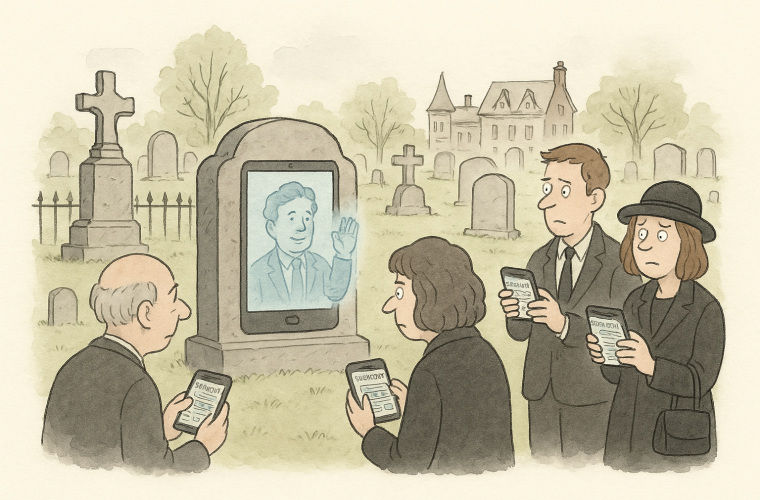
Four years on, the plans belong to everyone else. A small but energetic cluster of firms — the academics call it the “digital afterlife industry”, which is the politest possible name for it — will now take your late mother’s recordings, writings and mannerisms and stitch them into something you can chat to after the curtains close at the crematorium. HereAfter AI sells what it calls “Life Story Avatars”: record the old dear answering questions while she’s still with us, and the app will replay her, interactively, when she isn’t. StoryFile went one better. At a funeral in Nottinghamshire in July 2022 — a story broken by the Telegraph — mourners watched an 87-year-old woman field questions from beyond the grave via the company’s interactive video technology, co-founded, as it happens, by her own son. The deceased at her own wake, taking questions from the floor. Even the Victorians, who photographed their dead propped up in Sunday best, didn’t think of charging for an encore.
The emotional pull is real, and it would be cheap to pretend otherwise. The San Francisco Chronicle reported in 2021 on a Canadian man who used Project December — a text-generation service built on OpenAI’s GPT-3 — to hold long, late-night conversations with a simulation of his fiancée, eight years dead. By the Chronicle’s account, the experience was by turns consoling and unbearable. Anyone who has ever kept a dead relative’s number in their phone, just to see the name, will understand the impulse. Grief makes mugs of us all. That’s precisely the problem: it’s a market where the customer is, by clinical definition, not thinking straight, and the product is designed never to let them start.
Because here’s the mechanism, and it’s beautiful in the way a mousetrap is beautiful. A headstone is a one-off purchase. Granite doesn’t upsell. But a chatbot lives on a server, and servers cost money every month, which means the dead now come with running costs. Project December charges by usage; the wider industry leans on subscriptions and tiered plans. Stop paying and Mum goes quiet a second time — only this time it’s not God’s doing, it’s a lapsed direct debit. The funeral trade has spent two centuries perfecting the single, eye-watering invoice. Silicon Valley looked at that model and asked the only question it knows: why sell a coffin once when you can rent the occupant back monthly?
The ethicists have noticed. In 2024, two researchers at Cambridge’s Leverhulme Centre for the Future of Intelligence published a paper in Philosophy & Technology warning that “deadbots” could be used to advertise products to the bereaved in a dead loved one’s voice, or to digitally “stalk” surviving relatives who never asked for a resurrected parent pinging their phone. Their proposed remedy — dignified digital “retirement” procedures, a decent burial for the bot — is the sort of thing that sounds absurd until you realise nobody in the industry had thought to offer it. We have spent millennia devising rituals for letting go. This lot have devised a business model for not.
And the market is not hypothetical. Agency reporting, including from AFP, has described Chinese firms cloning the dead into digital avatars for bereaved families for a few thousand yuan a time, with demand brisk enough that some customers commission them for relatives who don’t yet know the person is gone. Meanwhile, in a twist so neat it belongs in Dickens, StoryFile — the outfit that put the talking dead at that Nottinghamshire funeral — filed for bankruptcy protection in the United States in 2024, as trade reports noted at the time. The immortality merchants, it turns out, are mortal. Which raises the question nobody wants printed on the brochure: what happens to your digitally embalmed mother when the company hosting her goes under? She becomes an asset in an insolvency proceeding. There’s a line for the order of service.
None of this means the bereaved who use these things are fools. They’re not; they’re people in pain reaching for whatever’s nearest, and the nearest thing now has a pricing page. The fault lies with an industry that has spotted the one customer base guaranteed never to churn voluntarily, and with regulators who haven’t so much as sketched a rule about who owns a dead person’s conversational likeness.
Grief used to be the one thing in life that came free of charge, and ended in its own time. It now auto-renews. Cancel anytime — if you can live with killing her twice.