
Prometheus stole fire from the gods, handed it to humanity, and spent the rest of eternity chained to a rock while an eagle ate his liver — which regrew overnight, so the bird could start fresh each morning. In February 2023, Microsoft announced that the technology behind its new Bing chatbot was called, and you’re ahead of me here, Prometheus. Either nobody in Redmond read to the end of the myth, or somebody did and decided the liver was another department’s problem. Ours, as it turns out.
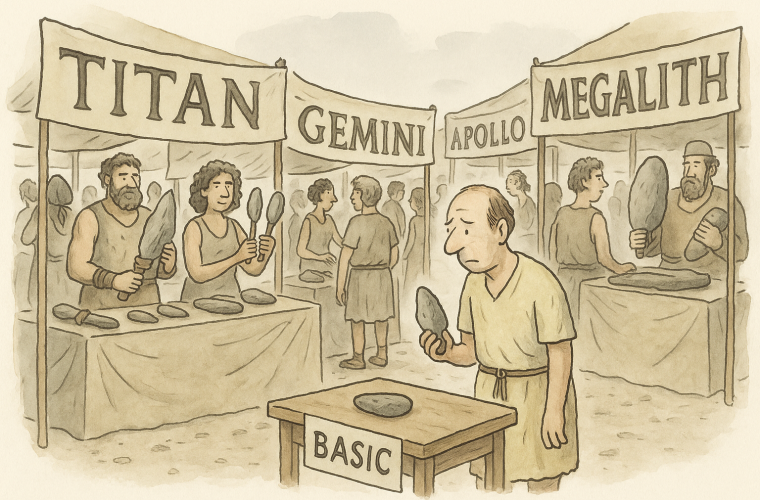
It wasn’t a one-off. Google’s flagship model is Gemini, the heavenly twins. Amazon flogs its foundation models under the brand Titan — the primordial gods who, anyone who stayed awake through classics will recall, were overthrown by their own children and buried under a mountain. Anthropic’s biggest, priciest tier of Claude is called Opus, a word ordinarily reserved for Wagner and papal encyclicals. Reuters reported in late 2023 that Amazon had an enormous model in development codenamed Olympus, because once you’ve spent the Titans there’s nowhere left to go but Zeus’s home address. And hovering over the data side of the whole carnival sits Palantir, named — by its founders’ own cheerful admission — after Tolkien’s seeing-stones: magical artefacts whose main narrative function, in the books at least, is to drive their users round the bend by showing them precisely what a hostile power wants them to see. You couldn’t make it up. Happily, you don’t have to.
So here’s a genuine question, not a rhetorical flourish: what does a name like that do to you before you’ve typed a single prompt?
I’ll tell you what it does. It settles the argument before the argument starts. Call a piece of software Titan and every conversation about it begins three rungs up the ladder of awe. The “handover of intelligence” — that solemn story in which humanity gracefully passes the torch to its silicon successors — stops being a claim that needs proving and becomes an atmosphere you’re already breathing. Nobody has actually demonstrated the intelligence. But the christening happened years ago, the font was booked, the vicar’s been paid. The branding is doing the arguing, and doing it rather well, because branding never has to survive peer review.
It’s the oldest trick in the estate agent’s binder. A damp one-bed above a kebab shop becomes “The Belvedere” and suddenly the asking price grows a conservatory. Nobody’s lying, exactly; they’re letting the name do the heavy lifting the property can’t. Now run the experiment in reverse. Suppose Gemini had launched as Statistical Autocomplete (Enterprise Edition), or Opus as Very Large Spreadsheet With Opinions. Same weights, same benchmarks, same occasional habit of inventing court cases. Would we be having earnest parliamentary hand-wringing about a successor species? Would anyone be drafting its rights? Would they hell. Nobody kneels before a spreadsheet.
None of this is new, of course. The Victorians and their heirs bolted “Imperial” onto anything with a warehouse and a letterhead — Imperial Chemical Industries, the Imperial Typewriter Company — on the sound commercial principle that a customer who feels part of an empire won’t quibble over the invoice. The typewriters, for the record, did not administer an empire. They typed.
And don’t mistake the doom-mongering for humility, either. “Our product might end civilisation” is not a confession; it’s the deluxe tier of the same advert. A god that might smite you is still a god — still worth tribute, temples and a monthly direct debit. What nobody selling a deity can afford is for you to conclude you’re looking at a tool: useful, flawed, occasionally dodgy, covered by consumer law. Prometheus commands a rock, an eagle and three thousand years of poetry. A faulty toaster commands a refund. The names exist to keep us firmly in rock-and-eagle territory.
Which is the quiet genius of the whole racket. The question we ought to be asking — is this thing intelligent, or a very good mimic with a marketing budget the size of Belgium? — has been swapped for a different one: are the gods kind? The first question can be tested. The second can only be worshipped over, argued about and monetised indefinitely. Give it eighteen months and someone will launch a model called Mythos, or Fabele, or Ineffable Pro Max, and the tech press will type it out with a perfectly straight face, and another rung of the ladder will quietly vanish beneath us.
The Greeks, to their credit, at least understood their own con. At Delphi the Pythia delivered her utterances and a rank of priests translated them into advice — for a fee, and phrased ambiguously enough that the oracle could never technically be wrong. Swap the temple for a data centre and the priests for a developer-relations team and the business model has barely moved in three millennia. The god never talked back. The priests always did. And the priests always, always sent an invoice.