
I found the field the way one finds anything now: scrolling. I had been looking, in the idle, half-serious way of a certain kind of Londoner in a certain kind of June, at property in the eastern counties — the daydream search, the one you run late at night with filters set a little beyond your means, to see what the dream is currently charging. And there, between the barn conversions and the executive closes, was a farm outside Littleport. Offers over £1,425,000 — and reduced, the site noted, the little flag that quickens every browser’s pulse. For the money: a five-bedroom farmhouse of four and a half thousand square feet, a two-bedroom gatehouse “highly profitable as an AirBnB,” stables, barns, a stable block “thoughtfully converted into a bar,” a fully lined and well-stocked fishing lake with a fountain and a jetty and bathing steps, and ten acres of gardens, woodland and meadow “framed by hundreds of mature trees.” Previously Award Winning Holiday Park & Wedding Venue, said the particulars. Haven for Wildlife — An Oasis in the Fens. Power and water across the whole site; parking for forty cars; and, listed among the attractions for “those seeking future potential,” an existing planning consent for a glamping site with associated visitor facilities. It looked, as these things go, like an astonishing deal, and that was the trouble. An oasis does not discount itself. Somewhere under the brochure adjectives a question was sitting with its hands folded, and the question was the oldest one in the property pages: why are they selling? — and its harder sibling, why has nobody bought? So I did what the listing was politely designed to ensure no one did. I searched the farm’s name against something other than the word sale.
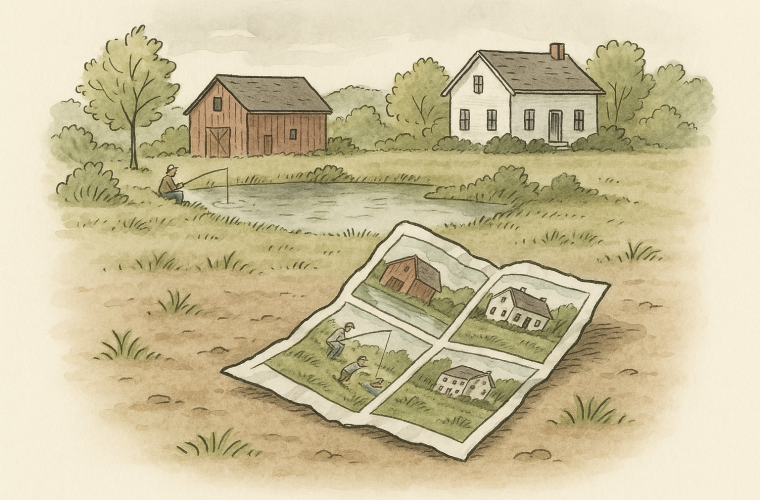
Among the listing’s photographs is one taken from the air, by drone, and it is the one I keep returning to. It shows the meadow: a long, irregular wedge of rough grass, hemmed on every side by trees — a dense rank of poplars along the northern edge, planted decades ago against the fen blow, and a looser, wilder line of willow and hawthorn to the south. Beyond the trees the arable begins: the vast, flat, tawny geometry of the Fens, fields the colour of biscuit running off to a horizon that is nowhere interrupted. And in the middle of the wedge, if you look closely, you can see paths. They wander. They are not the paths of agriculture, which run straight, because machines run straight; these curve and split and rejoin, they loop toward a clump of fruit trees and away again, they make a long lazy S from a gap in the northern trees down toward the lake. They are desire paths, worn by feet, and the feet were mostly small ones, and the paths are still there, printed into the grass, though by the time the drone went up no one had walked them for a long while. It is an estate agent’s image — a picture that exists to make land legible as asset. But land holds memory longer than it holds value, and what the photograph actually shows, once you know what happened here, is something closer to an archaeological plate: the trace evidence of a settlement, recently abandoned, whose people left in grief. The field lies at the end of a lane in a hamlet called Horsley Hale, a mile or so outside Littleport, which is itself a few miles north of Ely, whose cathedral — the Ship of the Fens — rides the horizon hereabouts the way a container vessel rides an empty sea. For seven years, from 2017 to 2024, this field was a glampsite called Horsley Hale Farm. Ten giant bell tents stood in the meadow in a loose village, six metres across, with handmade super-king beds inside them and solar-powered lights strung between. There were alpacas, and chickens, and a lake stocked with mirror carp and tench and chub which no one was permitted to catch. There was a campfire at the centre of everything, covered over if it drizzled. Children built dens in the strip of woodland. On the last Friday of August 2023, at about a quarter to seven in the evening, in fine weather and good light, a car moving at low speed across the grass struck and killed a two-year-old girl from east London named Isabella Tucker.
The following January, the owners announced that the site would not reopen. “After seven glorious seasons of hosting guests,” their statement began, “we are closing the gates to the glampsite.” The particulars do not mention any of this. There is no reason they should; the law asks an agent to disclose subsidence and flight paths and disputes with the neighbours, not sorrow. But it means the listing and the record now sit side by side on the same screen, describing the same ten acres in two languages that cannot hear each other — scope for Class Q development in one window, multiple traumatic head injuries in the other — and this essay is written out of the silence between those two windows. It is about the field, and the dream that was built on it, and the sentence I have just quoted from the owners’ farewell, which I have come to think is one of the saddest sentences in the English language — not for what it says but for what it cannot bring itself to say.
II.
The first thing to understand about the Fens is that they are not a landscape. They are a machine. Every acre of that black, biscuit-coloured, absurdly fertile plain is below the level of the rivers that cross it, and some of it is below the level of the sea, and all of it stays dry only because water is perpetually lifted — by pump now, by steam engine before that, by windmill before that — up out of the land and into rivers that run, embanked and unnatural, above the fields they drain. Turn off the pumps and the whole of it, the beet and the wheat and the celery, the lanes and the bungalows and the little Baptist chapels, would go back under water within a few seasons, and the country would return to what it was for most of human history: a vast, silver, reed-whispering marsh, one of the last genuinely wild places in lowland England. The people who lived in that marsh did not want it drained. They fished it and fowled it and cut its reeds, they moved through it on stilts and flat-bottomed boats, and when the Dutch engineer Cornelius Vermuyden arrived in the seventeenth century, with capital from the Earl of Bedford and a scheme to turn their world into cornfields, they fought. They broke the dykes at night. They burned the tools. The drainers called them the Fen Tigers, and they lost, as such people always lose, and the wet world was converted into the driest of assets: land.
But the land never quite forgave the conversion. The peat, once drained, began to shrink — it oxidises, wastes, blows away in black storms the locals call fen blows — so that the fields sink lower every decade while the rivers stay where they are, and the margin the pumps must overcome grows always a little wider. At Holme Fen, south of Peterborough, an iron post driven flush with the ground in 1851 now stands some four metres proud of it. The Fens, in other words, are a paradise that must be maintained by perpetual effort against the pull of what the place actually wants to be. It is the most artificial ground in Britain, and the most fragile, and everyone who lives on it knows, somewhere below thought, that its condition is temporary. I do not think it is fanciful to say that this knowledge gets into everything the Fens contain. It is a landscape in the subjunctive mood. It says: all of this is here only for as long as nothing fails. Littleport, for its part, carries a darker memory. In May 1816, in the hungry year after Waterloo — the year without a summer, when the ash of Tambora dimmed the skies and the harvests failed — the labourers of Littleport rose. They had come home from the wars to find bread unaffordable and wages falling; they armed themselves with pitchforks and fowling guns, sacked the houses of the better-off, and marched on Ely behind a wagon mounted with punt guns. The rising lasted two days. The yeomanry rode them down, the assizes were swift, and five Littleport men were hanged at Ely and buried in a common grave at St Mary’s, where a plaque now remembers them. The judge told them they had committed crimes against a social order that was, he did not doubt, providential. The order in question was the one the drained land had made: grain as property, hunger as discipline, the field as asset. It is not a place, in other words, without practice at the burial of its children by forces nobody in particular intended. I rehearse all this not as scenery but because I do not believe you can understand what was attempted at Horsley Hale Farm — or what its ending means — without it. When, in January 2017, three people bought a smallholding at the end of a lane outside Littleport and set about turning it into a small paradise for families, they were doing the oldest thing that has ever been done in that country: making an Eden out of a field, by effort, against the odds, on ground that keeps its own counsel.
III.
The three were Stuart and Steph Hatton, a married couple with young children of their own, and a partner, Ro Asplin. What they bought was not much to look at — a farmhouse, some outbuildings, the wedge of rough meadow, the belt of trees, the lake. What they intended to build there they described, over the years, in the plain, hopeful language of small-business websites and local-magazine features, and it is worth listening to that language carefully, because it is the language of a dream so modest and so decent that it is hard, now, to read it at all. They would host weddings first — the lake, with its reeds and irises and its three big willows, made a natural ceremony ground — and then, gradually, they shifted toward glamping, and toward a very particular vision of it. “A lot of glamping sites are adults-only,” Stuart Hatton told a Cambridge lifestyle magazine in September 2022, “aimed at those seeking a bit of peace and quiet, but we have a relatively young family, and wanted to position ourselves as somewhere you can bring the kids.” The offering, as the trade says, was childhood itself — a certain kind of childhood, remembered or imagined from the decades before screens: den building in the wood, dreamcatchers, feeding the alpacas, an old-school sports day, bread twists and hot chocolate at the campfire. Pedalos on the lake. Fish you could feed but not catch. For the parents there was cocktail-making and yoga by the water, and — Steph Hatton said this to the same magazine, and one hears the practical kindness in it — the promise that “if the parents can get a few hours to themselves while the kids are being entertained by somebody else, that always goes down well.” They composted. They put a ten-kilowatt solar array on the farmhouse roof and generated more power than the business used. The toilets were waterless, saving — the website kept the tally — hundreds of thousands of litres of drinking water a year. The bar stocked local beer and local apple juice and local ice cream. None of this made anybody rich; it is the kind of enterprise in which the margin is mostly meaning. Guests understood what was being offered and reached for the right word with striking consistency. An oasis, they called it, an oasis in the Fens — and an oasis, note, is precisely a paradise defined by the hostile immensity around it, a garden that exists by grace of the spring beneath it and would be desert without. By the summer of 2023 the site had eighty-six reviews on TripAdvisor and eighty-two of them awarded the full five stars. I have read a great many of them, and they form, taken together, a kind of chorus — the voice of English family happiness in the third decade of the twenty-first century, with its particular anxieties lying just beneath its particular joys. The children could roam, the reviews say, over and over. The children had freedom. One review, posted in August 2023 by a mother who had come with a group of young families for their first camping trip, praises the comfortable tents, the alpacas, the den building, the pedalos, the huge fish in the lake, the campfire covered against the drizzle, the giant fridge that kept everyone’s food, the kitchen that was so useful for making the children’s tea. “Everything was close by,” she wrote, “so ideal for little legs.” And then, in the middle of the review, a sentence of a kind that recurs throughout the chorus, a sentence that parents write almost without noticing, because it names the thing they are always, always checking for beneath everything else: “The site felt safe and everyone was so friendly.” August 2023. The same month. I want to be very careful here, because the point is not irony — irony is cheap, and there is nothing cheap in that sentence. The point is that she was right. The site did feel safe. It felt safe because an enormous amount of love and labour had been spent making it feel safe, and the feeling was the product, and the product was real. Every paradise we build for children is a feeling of safety erected inside a world that cannot underwrite it. The reviews are not evidence of anyone’s blindness. They are evidence of what the place truly was, seven seasons running, for hundreds of families, until the evening it wasn’t.
IV.
Ronald Street, E1, is a short road in Shadwell, in the borough of Tower Hamlets, a few hundred yards north of the Thames. I know the kind of street: flat-fronted terraces and post-war blocks, cars nose to tail along both kerbs, the traffic of the Commercial Road audible day and night, the towers of the City rising to the west and the towers of Canary Wharf to the east, so that the street sits in a trench of sky between two walls of money. Tower Hamlets is one of the most crowded places in Britain, and among the youngest; it is a borough teeming with small children and desperately short of ground for them to stand on. The green space rations out to a few square metres per child. Grass, in Shadwell, is municipal, fenced, signposted, shared with ten thousand others.
Isabella Tucker lived on Ronald Street. She was two years old in the summer of 2023, the younger of two sisters. In the last week of August her family did what the whole chorus of those reviews describes: they packed the car and drove the eighty-odd miles north-east — out through the retail sheds of the A12 or up the M11 past Stansted, out of the trench of sky and into the widening light of East Anglia, where the horizon drops and drops until, past Ely, it lies down flat altogether — to spend the bank holiday week at an oasis in the Fens, where the tents were comfortable and everything was close by, ideal for little legs, and children had the one thing the city cannot give them, which is room. I do not know, and will not pretend to know, what that week was like. But the reviews have told us what the place did with children, and the family later said one thing publicly that tells us what kind of week it was: on that Friday evening, Isabella was playing with her sister and her cousins. Cousins — so it was one of those holidays, the kind the site was built for, a group booking, sisters and their children, the giant fridge full of everyone’s food. It was the last Friday of August. The light in the Fens at a quarter to seven on an August evening comes in low and long over the poplars and turns the grass the colour of honey. One imagines — and I flag it as imagining, because this is the kind of evening the whole enterprise existed to produce and the reviews describe it again and again — the barbecues going, the smoke standing up straight in the still air, the adults beginning the long amiable negotiation of bedtime, the children extracting the last of the day. What happened then is recorded in the flattest language our civilisation possesses, the language of the collision investigator and the coroner, and I am going to leave it in that language, because the flatness is a mercy and I have no wish to trade it for effect. A red Mazda CX-5 drove forward at low speed on a grass field. The child came into contact with the front nearside of the vehicle. The investigation found no defects with the car. The collision occurred in daylight, in good visibility, in favourable weather. Forensic examination established that the child may not have been visible to the driver. The police investigation was unable to establish her precise movements immediately beforehand; it appears she was in close proximity to the front nearside when the vehicle moved off. That is all. That is the entire mechanism of the catastrophe: a car moved off across the grass, slowly, in golden light, and a person made of two years and perhaps eighty-five centimetres was where no one could see her.
Among the guests that evening were people with medical training — holidaymakers themselves, families like the others — and they fought for her on the grass while the ambulance came out from the far side of Ely. She was taken to the Queen Elizabeth Hospital at King’s Lynn, forty minutes north across the black fields. She died of her injuries there. The cause of death recorded at the inquest was multiple traumatic head injuries, the result of a road traffic collision — that term of art, road traffic, standing strangely in the record, since there was no road, and the whole point of the place was that there was no road, only a meadow that felt, to everyone on it, like the negation of everything a road is.
V.
What does it mean that the child may not have been visible? At the inquest, concluded at Huntingdon nearly two years later, the area coroner for Cambridgeshire and Peterborough put on the record the finding I have already quoted, and it deserves to be sat with rather than passed over, because it is the moral centre of the whole event and it is a sentence about geometry. A Mazda CX-5 is a tall car, as most family cars now are; its bonnet stands at roughly the height of a two-year-old child. Every such vehicle carries, welded into its very shape, a zone at its front corners in which a small child simply does not exist optically — a blind acreage that no attentiveness, no love, no degree of care can see into, because the seeing is forbidden by the metal. We have, over two decades, and for reasons of fashion and perceived safety, made the national family car steadily taller, and the blind acreage steadily wider, and we do not think about it, because thinking about it is unbearable and because almost always, almost everywhere, nothing happens. I said at the outset that I would name no one who does not choose to be named, and I will not, and this is why the driver of the car appears in this essay only as the coroner’s finding: a person to whom the child may not have been visible. A woman in her forties was arrested that evening on suspicion of causing death by careless driving, and bailed, and rebailed through the winter while the file went back and forth, and the last public record is procedural and inconclusive, and there the public record ends — no trial reported, no conviction reported, nothing. The coroner’s conclusion is the closest thing to a verdict the record contains, and read plainly it is a kind of acquittal pronounced upon everyone at once, and it is the most frightening sentence in the file. Because a villain would be a comfort. A villain would mean the paradise was betrayed, that safety failed because someone failed it. Instead the record offers us this: everyone was doing what the place invited them to do. The children were roaming, because roaming was the product. The car was on the grass, because on a working smallholding turned campsite the grass is also the yard and the track and the car park; that is what informality means, that is what the escape from kerbs and signage and municipal fencing consists of. The adults were friendly and the site felt safe and the light was good and the weather was fine, and the machine we have all agreed to build our lives around was standing in the meadow with its blind acreage in front of it, as it stands in every meadow, on every campsite, outside every school in the country. The horror of the English pastoral dream — and I have come to believe it deserves the word horror, in its exact sense of the thing that cannot be looked at directly — is not that it is false. It is that it is true right up until the instant it is not, and that the instant is generated by the dream’s own ingredients. Freedom for the children; informality for the adults; the car brought right up onto the grass so that the city can be unloaded into the field. Remove any one element and nothing happens. Combine them, ten thousand times, on a thousand sites, through the great post-pandemic flowering of English glamping — all those farmers’ fields converted in a season or two into little Arcadias, faster than any framework of rules could follow — and on some single evening, somewhere, in statistics’ own good time, the geometry completes itself. It completed itself at Horsley Hale on the 25th of August 2023 at about 6.45 in the evening, and of all the people it could have chosen it chose a two-year-old from a street with no grass on it at all.
VI.
Her mother’s tribute said: “A beautiful daughter and little sister. It’s so easy to love you. Loved you from first sight and will love you forever.” Neighbours and strangers raised seventeen thousand pounds to bury her — the sum overshooting its target by two thousand, the way such collections do, because the smallness of a funeral’s cost, set against the size of the thing, shames people into giving more. The owners’ statement, in the first days, said they were absolutely heartbroken, and thanked the emergency services and their guests, and asked for privacy for everyone involved, and there is no reason on earth to doubt a word of it. And then the site went quiet. The tents came down at the season’s end as they always did. The alpacas, one supposes, went on being fed. The winter of 2023–24 closed over the Fens as it does — the long brown floods lying on the washes, the wind with nothing to slow it between Littleport and the Urals, the lit windows of the farmhouse very small in all that dark — and I picture, and say plainly that I am picturing it, the owners at the kitchen table in that darkness with the booking system open in front of them, the deposits for the following summer already sitting in the account, each one a family, each family a meadow full of roaming children, and every child now carrying the blind acreage before it wherever it went. Whatever they saw when they closed their eyes, they had seen it at closer range than anyone who will read this. There are enterprises that can survive an accounting loss and cannot survive a change in what the owners see when they look at their own field. On the 31st of January 2024, they announced the closure. The statement is four sentences long and I have read it more times than any other document in this file. “After seven glorious seasons of hosting guests, we are closing the gates to the glampsite. Thanks to everyone who has chosen to work here, stay here, party here or even get married here. It’s been the most rewarding thing we’ve ever done and we’ve met some amazing people along the way. Those folks we couldn’t have done without, you know who you are.” Bookings would be refunded in full. They were truly sorry for any inconvenience. The statement does not mention Isabella Tucker. And the longer I have looked at it the more certain I have become that this omission is not evasion but its opposite — that the statement is about her in every clause, that she is the pressure under every word, and that the words are arranged the way English words of a certain generation and class and temperament are always arranged around the unbearable: in the form of thanks. Seven glorious seasons. Not eight; the eighth was already paid for. Glorious — a word from the language of summers and of war memorials, and doing, here, both of its jobs at once. The most rewarding thing we’ve ever done. You know who you are. It is a eulogy that dare not name its subject, grief in the national dialect, which is euphemism; and beneath its surface you can hear the actual sentence, the one that could not be typed into a Facebook post announcing refunds: a child died on our grass, and we cannot do this any more.
They were sorry, the last line says, for any inconvenience their closure might cause. I do not know a colder or a sadder use of the word inconvenience anywhere in English prose, and I mean that as praise. The word is a dyke, and behind it is the sea.
VII.
The aerial photograph was taken after the closure. This is evident from what is missing: no tents, no cars, no pale scatter of picnic furniture, none of the comma-shaped shadows that people cast when photographed from directly above at evening. The lake shows as a dark absence among its willows. The fruit trees have dropped whatever they carried. And yet the field, seen from four hundred feet, is not empty at all, because the paths are still there — that wandering, splitting, rejoining script worn into the grass by seven seasons of small feet, still legible from the air the way the ridge-and-furrow of deserted medieval villages is legible from the air, long after the people, the plague or the enclosure or the sheer running-out of luck that emptied them. Archaeologists have a term for such marks: they call them negative features — the record not of what was built but of what was worn away, ground surrendered to repeated passage. The Fens are full of them. From the air over Littleport you can see the roddons, the pale silted ghosts of rivers that stopped flowing a thousand years ago, winding through the black fields that were once their beds; the land remembers every water that ever crossed it. Now it remembers this too. A path from the gap in the poplars down to the jetty. A path to where the alpacas were fed. A path into the trees where the dens were built, where a father in a green T-shirt once stood draping cut branches over a lean-to while children watched with their hands full of leaves. The grass will take some years yet to forget, and the peat beneath the grass, which forgets nothing, will keep some faint compaction of it more or less forever, one more layer in the long archive of drowned forests and vanished rivers and everything else that country holds in its black pages.
I said the Fens were a landscape in the subjunctive mood, kept dry against their nature by perpetual effort, and that everyone who lives there knows the arrangement is provisional. That is what was really being sold in the meadow at Horsley Hale, though nobody would have put it this way: a provisional arrangement, maintained by love and vigilance and compost toilets and solar lamps, in which childhood could be, for a week at a time, what we cannot stop believing it once was. The English dream of the safe green place is our oldest dream; it is there in the walled gardens of the illuminated manuscripts, in the vicarage lawns, in every visual and verbal cliché of the national imagination, and it has always been a drained landscape — a wetness of grief and chance pumped out of sight beyond the tree line, so that the grass can stay dry for the children. The pumps are love, and they are good pumps, the best we have ever built. But the water table does not negotiate, and one evening in August, in fine weather and good light, with everyone doing exactly what the dream asked of them, it found the low corner of the field. The gates are closed now, and the field is for sale. That is how I found it, and that is where this ends, because the listing is the story’s last document and in its way the most eloquent of all. A rare lifestyle and leisure estate in the heart of the Fens, it says. Tucked away at the peaceful end of a no-through road. The infrastructure remains in place. The planning consent — reference number 18/00831/FUL, the dream in its bureaucratic form, dated from the hopeful first year — remains live, and is offered to “those seeking future potential” as an asset, which legally it is. The consent does not know what happened on the land it covers. Consents don’t. The price has come down once already, the reduction sitting on the page like a small unexplained subsidence, and I found myself thinking that this is the only mourning the market knows how to do: it cannot say a child died here, it has no field for that, so it says reduced, and waits for someone whose searches were less thorough than mine, or whose need for the dream is stronger. And someone will buy it. The house is beautiful and the lake is stocked and the trees are mature, and the English dream of the safe green place did not die at Horsley Hale, because it cannot die; it is load-bearing, we have built too much of ourselves on it. In a year or five there may be tents in the meadow again, and children’s paths rewearing the old lines in the grass, joining the roddons and the ridge-and-furrow in the land’s long ledger of things people meant. Perhaps that is even as it should be. The reviews are still online, the way everything is still online, the chorus still praising, in the present tense, the friendliness and the fish and the safety of a place that no longer exists — our era’s particular form of haunting, the five-star ghost. Somewhere in east London there is a street with one fewer child on it, and a family for whom the word meadow will never again be innocent, and somewhere in the Fens there is a field waiting behind its poplars for the next people who want a paradise, holding its paths up to the sky like a page. Seven glorious seasons. The eighth was refunded in full. The rest is offers over.