
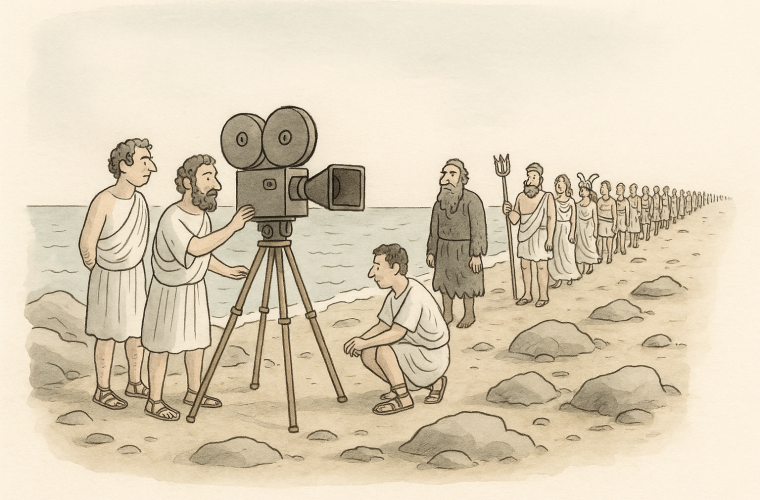
Twenty-seven centuries, give or take. That’s how long the Odyssey has been doing the rounds — recited by firelight, copied out by monks, mangled by schoolboys — and now, at last, it’s been granted the highest accolade our civilisation can bestow: a Christopher Nolan film, with a reported budget north of $250 million. Universal has pencilled it in for July 2026, with Matt Damon strapping on the sandals as Odysseus. The trade press treated the announcement as a thunderbolt. Bold. Audacious. Nobody’s ever dared.
Pull the other one.
Nolan isn’t blazing a trail here; he’s joining the back of a queue that stretches over the horizon and round the block twice. Kirk Douglas played Odysseus in an Italian production, Ulysses, back in 1954, complete with a Cyclops and some heroic dubbing. James Joyce spent years turning the poem into a single Dublin odyssey of pubs, brothels and funerals, published it in 1922, and it has been inflicted on English undergraduates ever since. And that’s before you get to the loose change: the nods, winks and outright liftings that pad out a full century of cinema.
Take O Brother, Where Art Thou? The Coen brothers slapped “Based upon The Odyssey by Homer” on the credits in 2000, then cheerfully told interviewers they’d never actually read the thing. It hardly mattered — the beats are all present and correct. George Clooney’s Ulysses Everett McGill escapes a chain gang to get home to his wife Penny (Penelope, obviously, for those at the back), dodging a one-eyed Bible salesman standing in for the Cyclops, a trio of singing women doing their washing by the river standing in for the Sirens, and a blind railroad prophet doing a turn as Tiresias. Crediting your source while admitting you nicked it second-hand, out of the general cultural soup — that may be the most honest attribution in Hollywood history. At least they put Homer’s name on the tin. Most don’t bother.
Kubrick didn’t need to. He borrowed the title outright for 2001: A Space Odyssey in 1968, and he and Arthur C. Clarke structured the thing around the epic quite deliberately: Dave Bowman as Odysseus adrift in the terrifying void, and HAL 9000 as the Cyclops — one cold, glowing red eye that has to be blinded, brain-module by brain-module, before the hero can get on with the business of coming home. The whole film is a voyage of return; it just swaps Ithaca for the far end of evolution.
Because once you know the shape — clever chap, long way from home, monsters and temptresses en route, bloody reckoning on arrival — you start seeing it everywhere. The Warriors (1979) is nominally cribbed from Xenophon’s Anabasis, but Sol Yurick’s novel and Walter Hill’s film run on pure Odyssey fuel: a gang fighting its way home across a nocturnal, mythical New York, one colourful regional monster at a time — the Baseball Furies being roughly what you’d get if the Laestrygonians shopped at a sporting goods counter. Cold Mountain (2003) plays it straighter: Jude Law’s Inman, a wounded Confederate deserter, trudging across a scarred America towards Nicole Kidman’s Ada, temptresses and symbolic perils dutifully lining the route. Charles Frazier openly modelled the novel on Homer; Hollywood duly filmed it and pocketed the prestige.
The arthouse crowd are at it too, in case you thought this was strictly a multiplex vice. Theo Angelopoulos’s Ulysses’ Gaze took the Grand Prix at Cannes in 1995 — Harvey Keitel as a Greek filmmaker dragging himself through the war-torn Balkans in search of three lost reels of film, wearing Odysseus’s spiritual exhaustion like an old coat. And Guy Maddin’s Keyhole (2011) shrinks the entire epic into one haunted house: a gangster called — subtle, this — Ulysses Pick, navigating his own gaff room by room, wading through ghosts of his past instead of wine-dark seas.
And if you want proof the story has soaked all the way down to the seabed: The SpongeBob SquarePants Movie (2004). No, seriously. A perilous journey to Shell City, a trench full of monsters, a giant Cyclops in the form of a deep-sea diver, and a sea god — King Neptune, Poseidon with the serial numbers barely filed — meddling throughout. When your three-thousand-year-old epic is being faithfully re-enacted by a cartoon sponge, the word “visionary” should probably be retired from the press kit.
The queue keeps moving regardless. Only in 2024, Uberto Pasolini’s The Return put Ralph Fiennes ashore on Ithaca opposite Juliette Binoche’s Penelope — arriving, with exquisite timing, just as Nolan was gearing up his own singular artistic vision.
Here’s the dirty little secret. Homer is the perfect business partner: dead for the better part of three millennia, no agent, no rights fee, no awkward notes on the third act. The material is pre-sold and gift-wrapped in prestige. Adapt a comic and you’re a hack; adapt Homer and you’re a custodian of Western civilisation. Same job. Better press.
In fairness — and a pint of fairness is owed — Homer was at it too. “Homer”, whoever he was or they were, stitched together generations of oral tradition, tales polished by a hundred anonymous bards. The Odyssey is itself a remix; the oldest story in the Western canon is a cover version. The whole edifice of Western storytelling rests on a bloke doing karaoke of other blokes’ material — brilliantly, mind, but karaoke all the same.
So the borrowing isn’t the crime. Stories survive by being retold. The crime is the branding: every retread flogged as a bolt from the blue, every filmmaker cast as a lone visionary wrestling virgin material, while the industry runs its oldest move — raid the public domain and invoice the audience for originality.
Nolan, to his credit, has kept Homer’s name front and centre, and he may well make a magnificent film; Homer has survived worse than an IMAX camera. But let’s not kid ourselves. A story pushing three thousand years old is being adapted for roughly the three-thousandth time — after the Coens, after Kubrick, after Keitel, after the sponge — and the marketing will still call it visionary. Homer, needless to say, won’t see a penny in residuals. The suitors, at least, had the decency to eat the man’s food to his face.