
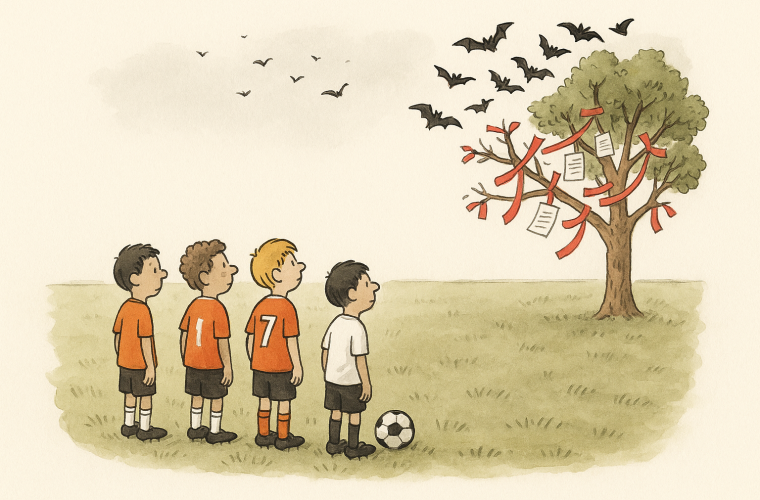
As scandals go, this one is missing all the usual furniture. No brown envelope, no burner phone, no minister discovered somewhere he shouldn’t be. Just forms. Forms, fees and a spreadsheet cell in which grassroots football quietly loses two all-weather pitches without anyone raising their voice, let alone a placard.
The mechanism is called Biodiversity Net Gain, and on paper it is the sort of thing only a monster would oppose. Under the Environment Act 2021, made mandatory for most developments in England from February 2024, anyone building anything must leave nature 10 per cent better off than they found it — and keep it that way for 30 years. Concrete over a meadow, and you must conjure up a slightly bigger meadow somewhere else, or pay someone who can. As principles go, it’s hard to argue with. Britain has spent a century paving things and expressing surprise when the skylarks leave.
The trouble is what the metric makes of a football pitch. A 3G surface — the rubber-crumbed artificial turf that lets kids train in January without contracting trench foot — scores essentially nothing for biodiversity. Lay one over a patch of tired grass and, in the eyes of the calculator, you have committed an act of ecological vandalism roughly on par with a car park, only with better drainage and worse parking. The liability must then be bought back: habitat created, units purchased, ecologists commissioned.
And so to the figure. According to numbers reported by the Football Foundation — the charity that channels money from the Premier League, the FA and government into grassroots facilities — net-gain requirements have already absorbed some £1.94m from its projects. By the Foundation’s own reckoning, that is the cost of two full-size community 3G pitches. Two pitches that will now never exist, traded for biodiversity units and consultancy reports. Nobody voted for that swap. It wasn’t in anyone’s manifesto. It simply fell out of the arithmetic, the way loose change falls down the back of a sofa, except the sofa is statutory and the change is seven figures.
The individual line items have a certain grim comedy. Ecological surveys can only be carried out in season — bats, per Natural England’s guidance, are surveyable roughly from spring to early autumn, which means a club that submits its paperwork in October can look forward to the best part of a year twiddling its thumbs while the bats hibernate, unbothered and unconsulted. Miss the window, wait for the wheel to come round again. Meanwhile, if no local habitat scheme can be found, there are statutory credits sold by the government as a last resort — priced, on Defra’s own published list, from £42,000 a unit for the cheapest habitats, and deliberately steep, the theory being that painful prices push developers towards the open market. A sound incentive for Barratt Homes. Rather less sound for a volunteer treasurer trying to get the under-11s off a mudbath.
Here is the properly British part: there is no villain. Not one. The ecologist counting bat passes at dusk is doing her job, and doing it well. The planning officer applying the metric is applying the law as Parliament wrote it. Natural England is enforcing exactly what it was told to enforce. Even the policy itself is, taken in isolation, perfectly defensible — habitat loss is real, developers did spend decades treating hedgerows as an inconvenience, and somebody had to send the bill somewhere. The cock-up, if that’s what it is, lives in the aggregate: a rule designed with the volume housebuilder in mind landing, with identical weight, on a community club whose entire annual budget wouldn’t cover a single statutory credit.
The obvious rejoinder is that exemptions exist — genuinely small works escape the net — and that carving out special pleading for every sympathetic cause is how good policy dies of a thousand cuts. Give football a pass and cricket will want one, then the scouts, then the allotment society, and before long the 10 per cent is a polite fiction. Fair enough. But the counter-counter is equally awkward: a community pitch is not a distribution shed. Its entire purpose is public good. Taxing it to fund a different public good is less a policy than a shell game, and the children doing the losing don’t get a consultation response.
The likeliest outcome, as ever, is a fudge. Some guidance will be softened, some threshold adjusted, a written ministerial statement will express warm feelings towards both bats and boots, and the system will grind on, marginally less absurd than before. Grassroots sport has survived worse; it will survey, delay and fundraise its way through this too, at the usual cost in volunteer evenings and abandoned schemes.
Still, it’s worth being clear-eyed about the ledger. £1.94m in, two pitches out. The bats, for what it’s worth, are doing fine. It’s the kids who’ve been surveyed out of a game.