
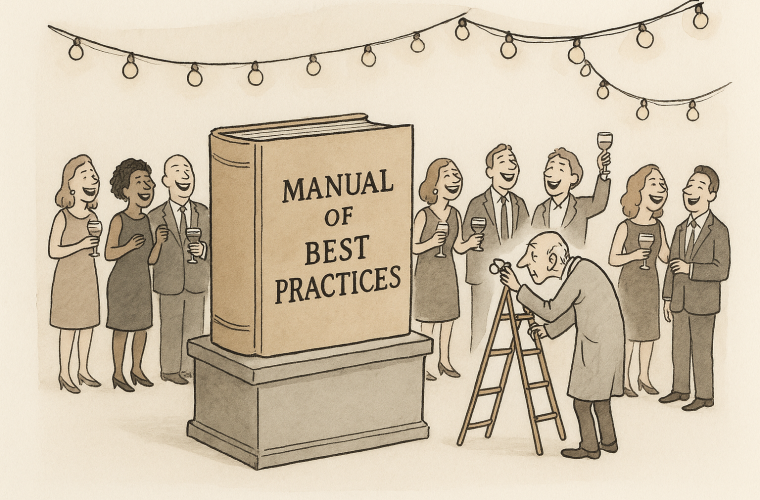
RFM. The old hands of the IT helpdesk have had it since the days of the dot-matrix printer, compressed into four letters: the tersest piece of moral philosophy ever committed to an acronym. Read The Fucking Manual. It is great advice that every ego-driven politician has woefully chosen to ignore. And on current evidence it ought to be stencilled above the door of the Oval Office and embroidered on the Resolute Desk.
Though the war seems to have settled down a bit, for how long who even knows. But consider the evidence as we move on. The Strait of Hormuz is roughly twenty-one nautical miles across at its narrowest point, and a fifth of the world’s oil squeezes through it. The likelihood that Iran, if attacked, would move to shut it has sat in CIA briefing material since 1983 — updated, war-gamed and handed to every incoming administration like the manufacturer’s warning label on the Middle East. Which is what makes recent events so grimly instructive. Donald Trump ordered strikes on Iran and was then, by every account to leak out of Washington, genuinely astonished when Tehran did the one thing four decades of intelligence said it would do. It closed the strait. The homework was in the folder. The folder was on the desk. Nobody opened it.
There is, believe it or not, peer-reviewed context for this sort of thing. Nearly nine in ten Darwin Award winners are men — 88.7 per cent, according to a paper published, with a commendably straight face, in the British Medical Journal’s 2014 Christmas issue. The authors proposed calling it “male idiot theory”. The Darwin Awards, for the uninitiated, commemorate those who improve the gene pool by removing themselves from it through acts of magnificent, avoidable daftness: fireworks, angle grinders, the immortal phrase “hold my pint”. The president has now given the genre a geopolitical wing. Hold my pint — only the pint is a fifth of the world’s oil, and the rest of us are holding it with him.
But this column is not really about the man who didn’t read the manual. He will furnish his own citations. This is in praise of the people who wrote it. Somewhere in Langley there is an analyst — several generations of them by now — who has spent a career keeping the Hormuz annex current. Updating the tanker traffic figures. Refreshing the mine-warfare assessments. Briefing it, year after year, to principals who nodded gravely and then did whatever they were always going to do anyway. That person is not the boring one in the Situation Room. That person is the reason there is still a Situation Room.
We have spent centuries mislabelling this trait. Call a man cautious and it sounds like an insult; call a woman cautious and it sounds like a diagnosis. But look at what the trait actually is. It is checking the ladder before you climb it. It is reading the leaflet in the paracetamol box. It is the flat-pack wardrobe assembled in the right order, standing plumb and true, while next door’s freelance genius has three screws left over and a door that opens like a haunted house. That isn’t timidity. That is competence wearing a cardigan, and it deserves a standing ovation rather than a patronising pat on the head.
And we know — properly, historically know — what happens when the manual-readers are allowed to lead. In 1935, Boeing’s Model 299, the most sophisticated aircraft of its day, crashed on a demonstration flight because a highly experienced crew forgot a single control lock. The response was not to find braver pilots. It was to write a checklist — a humble, unheroic, faintly nerdy piece of paper that turned the most dangerous machines humanity had yet built into some of the safest. Aviation didn’t get safer because pilots got bolder. It got safer because the industry institutionalised the instincts of the person who reads the manual. Statecraft, you’d think, might fancy a go.
Football supporters already understand this, even if they’d never admit it in these terms. Every great side has its Makélélé — the unglamorous genius who reads the danger two passes early and makes sure the catastrophe simply never happens. He doesn’t get the goal-of-the-month reel. He gets the trophies. The Trump doctrine, by contrast, is five strikers, no defence, and bafflement at half-time that you’re four down to a team whose tactics have been published since 1984.
Why, then, do we hand out medals for the swashbuckling recovery and only a shrug for the disaster that never happened? Partly because prevented catastrophes make terrible telly: nobody films the woman who checked the tyre pressure before the motorway, and nobody broadcasts the briefing that stopped a war. Partly because we’ve inherited a story in which courage means charging and prudence means cowering, and stories are stubborn things. But mostly because the readers of instructions don’t demand applause. They’re too busy making sure the gas is off.
Well, consider this the applause. To the analyst who kept the annex current through five administrations. To the man who watches the safety demonstration on the flight he’s taken forty times. To everyone who has ever said, in the face of enormous social pressure, “let’s just have a quick look at the diagram first” — you are not the boring ones at the party. You are the reason there is still a party. You are the load-bearing wall of civilisation, and civilisation, ungrateful sort that it is, has repaid you by calling you squares.
Somewhere in Langley, right now, someone is quietly updating the manual for the next incumbent. It says what it has said since the 1980s: strike Iran, and the strait closes. Mr President — whoever you turn out to be — do civilisation one small favour. Read the fucking thing.