
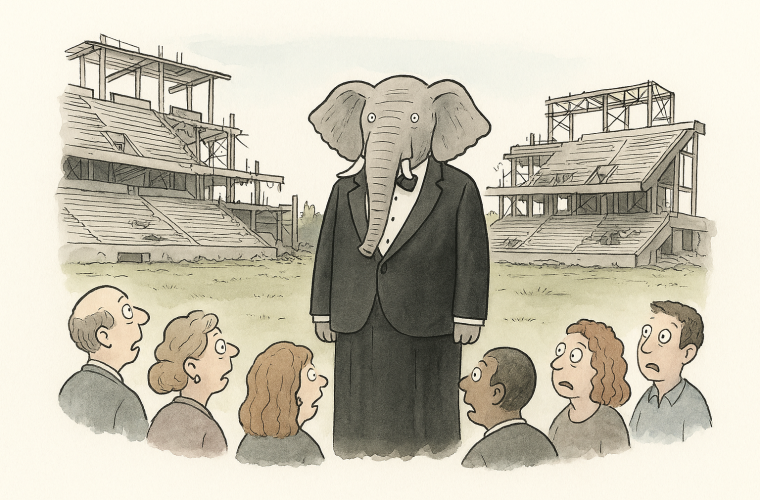
FIFA’s greatest gift to a host city, after nearly a century of trying, turns out to be absolutely nothing. Not a stadium. Not a tram line. Not one ceremonial breeze block laid by a bloke in a hard hat who’s never held a trowel. Nothing at all.
The 2026 World Cup — forty-eight teams, 104 matches, sixteen cities sprawled across the United States, Canada and Mexico — will be played entirely in stadiums that already exist. Not a single ground has been built for the occasion. For the first time in living memory, the circus has rolled into town without demanding the town first build it a new tent, at the town’s expense, to the circus’s specifications, with the circus keeping the ticket money.
And nobody at FIFA will say the quiet part aloud, so allow me: this is a confession. The whole ‘legacy’ pitch — the regeneration, the catalyst for investment, the gleaming arenas that would lift entire regions out of the doldrums — was always a con. You don’t quietly stop doing something that works.
Consider the receipts. South Africa in 2010 was sold the dream and ended up with Cape Town Stadium, a handsome great bowl at Green Point that spent years afterwards struggling to find anyone to play in it regularly, its running costs landing on ratepayers who’d been promised the earth. Brazil in 2014 went one better. The Arena da Amazônia was carved out of Manaus — a city deep in the rainforest with no top-flight club to speak of — at a cost in the region of $300m, for the privilege of hosting four group-stage matches. Four. Meanwhile Brasília’s vast Mané Garrincha stadium, one of the most expensive football grounds ever built, was being used within a year as a glorified depot for parking buses, as the wire agencies gleefully reported in 2015. Half a billion dollars of national ambition, repurposed as a car park. You couldn’t write it, except somebody did, in a feasibility study, and got paid handsomely for it.
Then Qatar, where the pretence collapsed entirely. Seven stadiums conjured from the desert for a country with no footballing hinterland to fill them, one of them — Stadium 974 — designed from the outset to be dismantled and carted off afterwards. A stadium built to disappear is at least honest about its own pointlessness, which is more than can be said for the rest. And the human ledger was darker still: the Guardian’s 2021 investigation found that more than 6,500 migrant workers from South Asia had died in Qatar in the decade after the tournament was awarded. FIFA’s response, broadly, was to talk about legacy some more.
This is the pattern, and it predates football’s involvement. Montreal spent thirty years paying off its 1976 Olympic stadium — locals christened it the Big Owe — finally clearing the debt in 2006, by which point the roof had failed more often than a British train operator. Mega-event economics is one of the few fields where the academics and the blokes down the pub are in furious agreement: the numbers never, ever add up for the host. They add up beautifully for the organiser, mind. FIFA has projected roughly $11bn in revenue for the four-year cycle ending with 2026 — a record, naturally, achieved without buying so much as a bag of cement.
Now, before anyone hands FIFA a medal for restraint, let’s be clear about why 2026 built nothing. It isn’t virtue. It’s that America had already done the overbuilding for them. The tournament will unfold largely in NFL cathedrals — vast, half-empty most of the year, and in many cases funded by American taxpayers strong-armed into subsidising billionaire owners under threat of the team skipping town. FIFA didn’t renounce the grift; it found a country where the grift had already been run, twice over, and simply moved in. It’s not temperance. It’s turning up to someone else’s party because the drinks are free.
And the hosts will still pay, of course. Security, transport, fan zones, the tax exemptions FIFA demands as a matter of routine — the tab never vanishes, it just shrinks from catastrophic to merely painful. But the concrete albatross, the thing that squats on a city’s balance sheet for a generation while the seats fade in the sun? Gone. Not commissioned. Refused, in effect, by accident.
There’s a lovely irony in the one genuinely storied venue on the 2026 roster. Mexico City’s Estadio Azteca will become the first stadium to host matches at three World Cups — 1970, 1986 and now this one. Its legacy wasn’t built for a tournament. It was built for football, used for football, and kept for football, which is why it’s still standing and still mattering while newer, shinier grounds park buses.
So here, finally, is the honest legacy of a World Cup, arrived at after decades of white elephants, cost overruns and ribbon-cuttings for buildings nobody needed: it’s the thing you don’t build. The stadium you decline. The rendering you bin. When FIFA next comes calling with a glossy brochure and a promise of transformation, every sensible city now has a precedent to point at. Show them what you’ve already got. And if that’s not good enough for them, show them the door.