The correct response to surviving a heart attack, in most of Europe, is a stiff drink and a solemn vow to eat more vegetables. In the Galician parish of Santa Marta de Ribarteme, it is to lie down in an open coffin and have your family carry you to church.
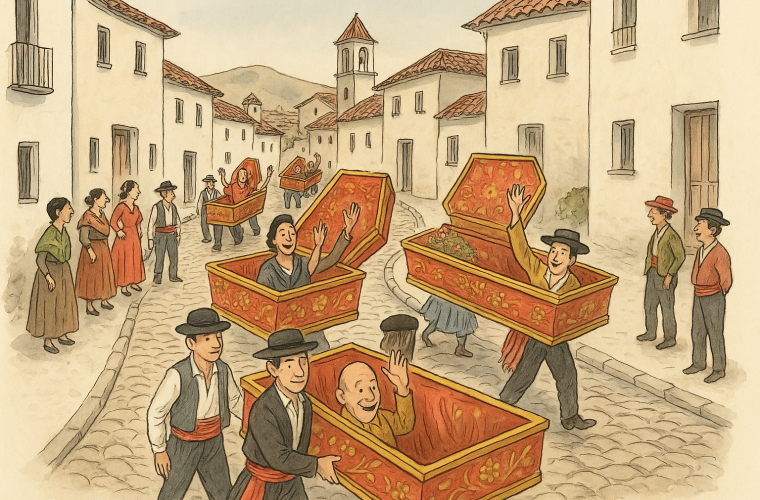
Every 29 July — the feast day of Saint Martha — this small parish in the municipality of As Neves, folded into the green hills of Pontevedra near the Portuguese border, stages what must be the most gloriously back-to-front procession in Christendom. Those who have cheated death in the previous twelve months — survivors of crashes, cancers, cardiac frights and other close shaves — are borne shoulder-high in coffins, very much alive, eyes open, hands folded, to give thanks at the little stone church that shares the saint’s name.
The choice of patron is no accident. Martha of Bethany was the sister of Lazarus, the most celebrated man ever to walk out of his own tomb. If any saint can be relied upon to stay relaxed about people climbing back out of coffins, it is the one who watched her brother do exactly that. There is a theological neatness to it that borders on cheek.
And so, once mass is said, the coffins process around the church, the not-quite-departed blinking up at the July sun while their nearest and dearest sweat under the weight of them. The pilgrims sing a verse promising the saint that they are bringing her those who have seen death — a lyric reported by the BBC among others — and the whole thing moves at the unhurried pace of people who have recently learnt there is no rush. According to the BBC’s dispatch from Ribarteme, those without relatives strong enough, or willing enough, to shoulder the load can hire bearers, while others simply walk the route behind an empty box. The gesture, apparently, counts.
Then — and this is the part that separates Galicia from every other place on earth — everyone goes to the fair. Because this is not a funeral. It is a romería, a proper Galician pilgrimage-party, and photographers from the international wire agencies have documented the scene year after year: octopus boiled in vast copper cauldrons, brass bands, fireworks after dark, and stalls selling wax effigies of arms, legs and heads to be offered to the saint in thanks for whichever body part she saw fit to spare. One minute you are lying in your coffin contemplating eternity; the next you are upright with a plate of pulpo and a glass of the local white, contemplating seconds.
It helps to know the neighbourhood. Galicia is Spain’s misty, granite, Celtic-edged corner, a land where death has always been less a stranger than a neighbour who pops round uninvited. This is the home of the Santa Compaña, the legendary night procession of souls that Galician folklore insists still wanders the lanes after dark. Some folklorists have speculated that the coffin pilgrimage carries echoes of pre-Christian rites — though that remains educated guesswork rather than gospel, and the parish itself is content to let the mystery keep its cassock on. What is certain is that nobody here finds it morbid. Quite the reverse.
Compare and contrast with how we manage these things at home. In Britain, surviving a genuinely close call earns you a card signed by the office, a mumbled “you gave us a scare, mate”, and an unspoken agreement never to mention it again. We treat a brush with death like an embarrassing incident at the Christmas do. The Galicians treat it like a cup run. Ribarteme is, in effect, a testimonial match for people who very nearly got relegated to the next life — the whole village turning out to applaud you off the pitch you almost left for good. And there is real wisdom in the wood. Lying in a coffin while your family carries you is memento mori and carpe diem nailed into a single box: here is where you were headed; isn’t it marvellous that you’re not there yet?
Spanish and international press have reported crowds in the thousands at the fiesta, pilgrims and gawpers alike, and it is not hard to see why the gawpers come. But the pilgrims are the point. Every one of those coffins holds a person who spent some portion of the past year being told the odds, and who has chosen to answer the darkest moment of their life not with silence but with a brass band and a plate of octopus.
Everyone, in the end, gets a funeral. The lucky few of Ribarteme get to attend their own — and then climb out, dust themselves down, and join the queue for lunch. There are worse definitions of being alive.