
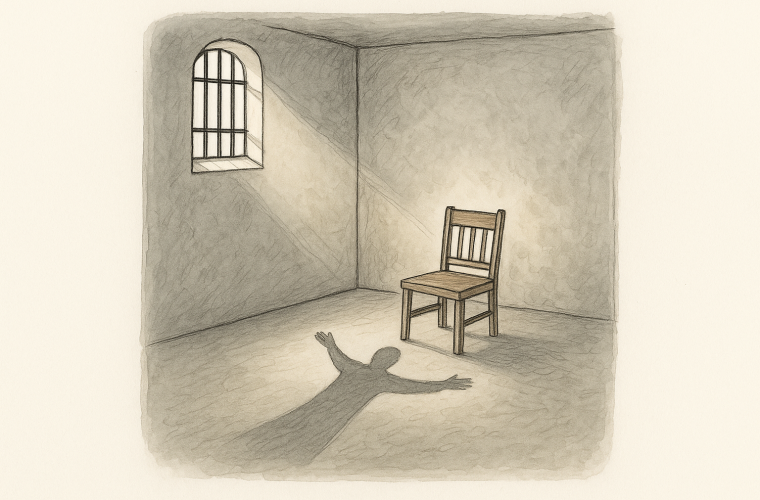
Why would a sane woman ask the Church to read something very like her own funeral rites while she was still breathing? In medieval England this was not a hypothetical. A woman seeking to become an anchoress — a religious recluse enclosed for life in a small cell attached to a parish church — would, in some rites, be blessed with liturgy borrowed from the Office of the Dead before the door was sealed behind her. Dead to the world, alive to God, permanent resident of a room roughly the size of a modern prison cell.
Which is the comparison worth sitting with, because we still build those rooms. We just stopped asking the occupants first.
The instinct itself is ancient and, on its own terms, perfectly coherent. The desert hermits of fourth-century Egypt walked away from the cities on the theory that if you strip away noise, company and comfort, what remains is the soul, and the soul can then get on with its proper business. “Go, sit in your cell,” runs the famous advice attributed to Abba Moses, “and your cell will teach you everything.” The Buddha, on a different continent and a different theology entirely, sat alone under a tree until the self dissolved and something like oneness turned up in its place. Turn inward far enough, the tradition says, and you come out the other side — solitude not as deprivation but as solace, the emptied room as the condition for being filled.
But notice the small print, because everything hangs on it. In every one of these traditions, the belief walks in before the hermit does. The cell teaches you everything only if you arrived wanting to be taught. The desert fathers chose the desert; the Buddha chose the tree. Nobody in the literature attains enlightenment because a magistrate sent them there.
The anchorhold understood this. Ancrene Wisse, the thirteenth-century guide written for a small group of English anchoresses, describes a rigorous vetting — the Church did not brick up just anyone — and a life with windows, plural: a squint into the church so she could follow the Mass, and an aperture onto the street through which the world queued up for advice. Anchoresses had servants, patrons and a steady trade in counsel. Solitude, yes. Abandonment, no.
The most famous of them, Julian of Norwich, spent decades in her cell and reported long, detailed conversations with God — sixteen “showings” she worked over for the rest of her life and set down in Revelations of Divine Love, commonly held to be the earliest surviving book in English written by a woman. From a bricked-in room in plague-hammered Norwich came the most quoted line in English mysticism: “All shall be well, and all shall be well, and all manner of thing shall be well.”
Hold that thought about the conversations with God. We’ll be needing it.
Because when the modern world invented solitary confinement, it thought it was building anchorholds. Eastern State Penitentiary, opened in Philadelphia in 1829, was the flagship of the “separate system”, championed by reformers with Quaker roots who genuinely believed that silence and isolation would turn the criminal inward towards penitence — hence “penitentiary”. Each man got a cell, a skylight, a Bible and some work. What he did not get was another human being. It was the desert fathers’ prescription with one ingredient missing: the volunteer. Enforced monasticism, on an industrial estate footprint.
Charles Dickens toured the place in 1842 and was having none of it. “I hold this slow and daily tampering with the mysteries of the brain, to be immeasurably worse than any torture of the body,” he wrote in American Notes. History, and rather a lot of clinical data, has sided with Dickens. In the 1950s, Donald Hebb’s sensory deprivation experiments at McGill paid students handsomely to sit alone in comfortable cubicles; most cracked within days, several hallucinating. In 1983 the psychiatrist Stuart Grassian examined isolated prisoners at Walpole in Massachusetts and documented a recurring cluster — perceptual distortion, paranoia, panic, hallucination — now known in the trade as SHU syndrome. Craig Haney’s studies of California’s Pelican Bay supermax found the same wreckage at scale. And in 2014, researchers led by Timothy Wilson published a study in Science showing that many participants, left alone with their thoughts for a quarter of an hour, preferred to give themselves electric shocks. Fifteen minutes. The United Nations, for its part, has settled on fifteen days: the Nelson Mandela Rules — the UN’s minimum standards for the treatment of prisoners, adopted in revised form in 2015 — define solitary confinement beyond fifteen consecutive days as “prolonged” and prohibit it outright, and Juan Méndez, the UN’s then Special Rapporteur on Torture, told the General Assembly in 2011 that isolation past that threshold can amount to torture or to cruel, inhuman or degrading treatment. Julian did four decades. Whatever she was running on, it does not come standard.
And here is where the comparison gets genuinely uncomfortable, so let’s not flinch from it. Julian had long conversations with God in her cell. So, by their own account, do a remarkable number of men on America’s death rows — including some of its most prolific murderers. Prison chaplains will tell you conversion in isolation is practically an occupational hazard. The room, it turns out, reliably produces voices; the empirical literature says as much. What the room cannot do is guarantee whose they are, or make the listener good. Julian’s revelations were tested against a chosen vocation, a community at her window and a lifetime’s disciplined reflection. The supermax version is tested against nothing at all — which is why one gets a place in the canon and the other gets a psychiatric assessment, and why, awkwardly, we cannot always tell from inside the cell which is which.
To be scrupulously fair to the prison service, nobody segregates prisoners for a lark. Some men are a genuine danger to everyone around them; some ask for isolation for their own protection. It is a grim trade-off managed by people with worse options than critics tend to admit. But there is a difference between conceding that isolation is sometimes the least-bad tool and pretending, as the Philadelphia reformers did, that the room itself does the redeeming.
It doesn’t. That is the lesson sitting in plain sight across seventeen centuries, from the Egyptian desert to the Close Supervision Centre. The walls were only ever scaffolding for a life the occupant had already chosen. Take away the choosing and you are not building an anchorhold. You are just digging a hole and waiting, against all the evidence, for a saint to climb out of it.
All shall be well, Julian promised. In her room — chosen, windowed, believed in — it broadly was. In ours, the data is in, and it broadly isn’t.