
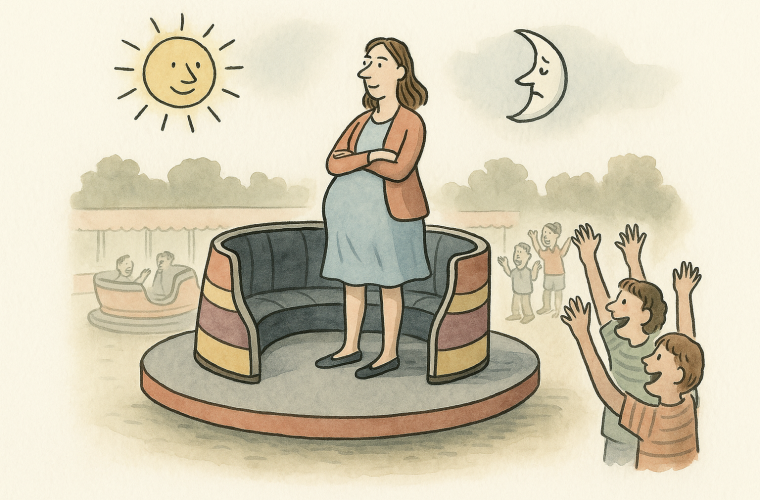
The Centrifugal Birthing Table and Other Patents That Should Have Stayed Dreams
There is a special filing cabinet in the cellar of human ingenuity, and it is stuffed to bursting with ideas that should have been quietly strangled at the napkin stage. Most never see daylight. A startling number, however, made it past a patent examiner — a person whose entire job is to ask “are you having a laugh?” and who, on these occasions, evidently was not.
Take the one that gives this piece its title. In 1965, an American couple by the names of George and Charlotte Blonsky were granted US Patent 3,216,423: an “Apparatus for Facilitating the Birth of a Child by Centrifugal Force.” Read that again slowly. The contraption strapped an expectant mother to a circular table, then spun her at speed so that the force flung the baby — gently, the inventors insisted, gently — out into a waiting net. The patent dutifully includes a fabric pouch to catch the new arrival before it could be launched across the delivery room like a rogby ball at a lineout.
The logic, such as it was, ran like this: women in “primitive” societies stayed physically active and pushed babies out with ease, whereas the modern mother had gone soft and needed a mechanical assist. The fact that the proposed assist resembled a fairground waltzer crossed with an obstetrics ward seems not to have troubled anyone holding the rubber stamp.
It is gloriously, hilariously mad. And it is far from alone.
The museum of misfires
There is a whole wing of patented daftness that arrives dressed as practicality. Chicken spectacles — yes, tiny glasses for hens — were a genuine commercial product, patented in the early twentieth century to stop the birds pecking one another to death. Some versions even came with little rose-tinted lenses, on the theory that a hen who couldn’t see blood wouldn’t go in for cannibalism. A solution, then, that asked the chicken to wear a monocle rather than asking the farmer to give it a bit more room. Very on-brand for the industry.
Then there is the alarm clock that smacks you in the face, an 1882 American patent that suspended a wooden frame above the sleeper’s head and dropped it on the bonce at the appointed hour. The inventor seems to have decided that the gentle indignity of being woken was insufficient, and what the sluggard really needed was a concussion with breakfast. One imagines a nation of Victorians staggering to work nursing lumps the size of conkers, grateful at least to be punctual.
The pattern repeats across the decades. There is the apparatus for burying people who might only be sleeping — a Victorian obsession, the safety coffin, fitted with bells and breathing tubes so the prematurely interred could ring for assistance from six feet under. There is the motorised ice-cream cone that rotates the scoop against your tongue so you needn’t suffer the exhausting labour of turning your own wrist. There is the full-body umbrella for dogs. Humanity, given a drawing board and a sliver of free time, will reliably produce something that solves a problem nobody has while creating three nobody saw coming.
Why the daft ones get through
Here’s the thing the mockery tends to skate over. A patent is not a seal of approval. It is not a panel of wise elders declaring your idea sensible, useful, or unlikely to fling a newborn into a net. A patent merely says the thing is novel, non-obvious and described clearly enough that someone could build it. Whether anyone should build it is gloriously beyond the examiner’s remit.
This matters, because it explains the cabinet. The patent system is a register of ambition, not of wisdom. It captures the moment a bloke in a shed thought “I bet I could improve childbirth with rotational physics” before anyone with a medical degree could grab him by the lapels. And honestly? That openness is the point. The same machinery that waved through the centrifugal birthing table also waved through the things that genuinely changed lives — the telephone, the lightbulb, the humble cat’s-eye road stud invented by a Yorkshireman who’d nearly driven off a foggy road. You cannot have one without the other. The cost of catching the occasional Edison is tolerating a great many spinning tables.
Which is rather comforting, when you sit with it. We laugh at the Blonskys because hindsight is a cheap seat and the view is excellent. But every one of these patents represents someone who looked at the world, found it wanting, and had a genuine go at fixing it. They were wrong. Magnificently, catastrophically, net-and-pulley wrong. But they tried, and they filed the paperwork, and somewhere a clerk in an office filed it back at them with a stamp.
The failures sit in the cellar gathering dust and laughs. The successes get statues and street names. The only real difference between the two, more often than not, is whether the thing actually worked — and at the moment of filing, nobody truly knew.
So raise a glass to the muppets with the drawings. The world is built by people daft enough to try, and the centrifugal birthing table is simply the ones who missed. Just, for the love of God, keep them away from the maternity ward.