
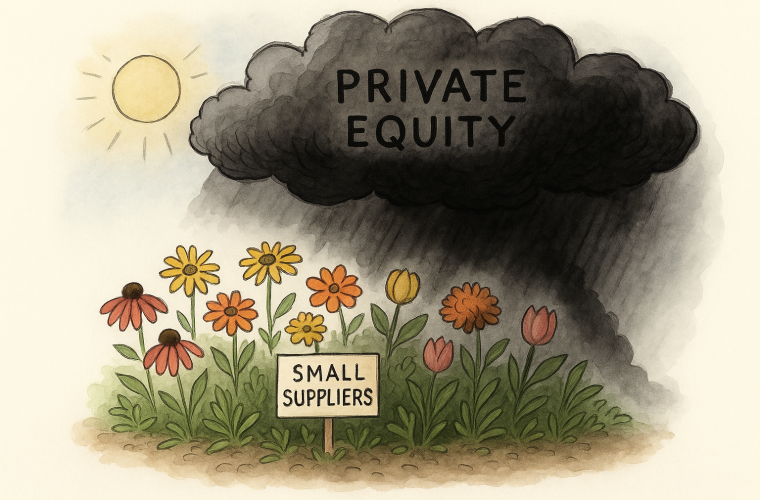
Fifty pence in the pound. That’s the going rate for a debt owed to the bloke who sold you the birthday cards, the till rolls, the boxes of paperclips that kept the high street ticking over. Knock half off and call it a day. Restructuring, they call it. The lads who used to run a market stall called it something else, but they didn’t have a magic circle law firm on retainer to make it sound respectable.
The story here is WH Smith, or at least the carcass of it that trades under the name Modella Capital saw fit to keep. Modella bought the high-street arm in 2025, rebranded the lot as TGJones — a name nobody asked for and nobody can pronounce on the first go — and set about doing what private equity does best: making the numbers work for the people at the top of the table while everyone below gets the bill.
And somebody always gets the bill. That’s the part the press releases never quite spell out.
The haircut nobody volunteered for
Let’s be clear about what a “50% haircut” actually means when you strip the City euphemism off it. A small supplier — let’s say a family card firm in the Midlands, the sort of outfit where the founder still does the VAT return at the kitchen table — sends WH Smith a year’s worth of stock on the usual terms. Net thirty days, a handshake, the comforting assumption that a household name with shops in every train station this side of Carlisle will be good for the money.
Then the restructure lands. And the family card firm discovers that of the money it’s owed, it’ll be lucky to see half. The other half evaporates into the ledger, written off so that the bigger, louder, more litigious creditors at the front of the queue can be made whole.
This is not a bug. This is the design.
Who’s spared and who’s skinned
Here’s the bit that should make your blood boil, and it’s worth saying slowly because it’s where the whole con lives. Not everyone takes the haircut. The big secured creditors — the banks, the landlords with deep pockets and deeper lawyers — tend to come out the far side of these arrangements remarkably unscathed. They’ve got security. They’ve got leverage. They’ve got the kind of relationship with the new owners that means a quiet word is worth more than a court order.
The paperclip merchant has none of that. He’s an unsecured creditor, which is City Latin for “sucker”. He sits at the back, he gets what’s left, and what’s left after the clever people have helped themselves is — surprise — about half.
Ask yourself who actually built the value in a shop like WH Smith. It wasn’t the buyout firm that turned up in 2025 with a chequebook and a rebranding deck. It was decades of suppliers turning up with the goods, on time, on trust. And now that trust gets monetised — by carving it up and handing the bigger slices to the people who least need them.
The flip is the point
Understand the business model and the rest stops looking like bad luck and starts looking like strategy. Private equity doesn’t generally buy a high-street name because it loves greetings cards. It buys to flip — to load the thing with cost discipline, trim what can be trimmed, dress up the balance sheet, and sell it on or refinance it at a tidy profit before anyone notices the foundations are made of other people’s unpaid invoices.
When you’re optimising for the flip, suppliers aren’t partners. They’re a line item. And a line item that can be told to accept fifty pence in the pound is a line item that’s just improved your margins by the difference. The card firm’s loss is, quite literally, somebody else’s return.
The genius of it — and you have to give the buggers their due, it’s a clever sort of awful — is that the pain is distributed thinly across hundreds of small outfits who can’t afford to fight it, while the gain is concentrated among a handful who could afford to fight but never have to.
Death by a thousand small invoices
Nobody marches on Westminster over a 50% write-down to a stationery wholesaler. There’s no telegenic victim, no single sympathetic face. It’s death by a thousand small invoices — each one too modest to matter, all of them together adding up to a quiet transfer of wealth from the people who make things to the people who arrange things.
And the high street, that thing politicians of every stripe claim to be heartbroken about, gets hollowed out one supplier at a time. Not by Amazon this round. By a buyout structure that treats the firms keeping the shelves stocked as a cost to be managed down.
We’re forever told the high street is dying of online competition and rising rents and the great British public’s refusal to leave the house. All true, up to a point. But sometimes the high street isn’t dying. It’s being asset-stripped with a smile, and the stationery bloke is footing the funeral bill.
Fifty pence in the pound. Take it or leave it. He’ll take it. They always do.